Fight the Dark Side With Countdown to ‘The Force Awakens’

The Force has awakened with a vengeance.

For the first time in 10 years, a new Star Wars movie will open in theaters — on Friday, Dec. 18, to be exact.

(If you’re a prequel denier, you might say it’s the first new Star Wars movie in 32 years.)

In this age of social media and relentless Internet coverage, the impending arrival of “Star Wars: Episode VII — The Force Awakens” has provoked obsession, curiosity and controversy, the likes of which have never been seen before.

Everyone has watched the trailers. Footage has been analyzed and reanalyzed and given rise to theories and speculation.

It’s difficult to get through a conversation without talk turning to the absence of Luke in the trailers — Is he dead? Is he the bad guy? What’s up with that robot hand? — or whose children Rey, Finn or Poe could be.

Everyone has fallen madly in love with a rotund little droid named BB-8.

You can’t set foot into a store without being confronted by shelves of plastic lightsabers, Kylo Ren action figures, and T-shirts. Oh, the humanity — the T-shirts!

In other words, it’s a wonderful time to be alive if you happen to be a Star Wars fan. Maybe the most wonderful time in all of history.

In celebration, we’re launching a month-long countdown to the theatrical debut of “The Force Awakens.” Beginning tomorrow, new Star Wars-related content will be featured on this blog almost every day.

We’ll have essays by fans about what the franchise means to them, stories examining the actors and filmmakers behind Disney’s ambitious new plans for George Lucas’ sci-fi universe, and photographic trips down memory lane.

You’ll also find links to some of our favorite Star Wars stuff online, as well as lifestyle features, including Christmas gift guides, essential swag for midnight screenings, and other helpful tips to make the month-long wait a little easier to bear.

This experiment in Lucasfilm love wouldn’t be possible without the many fascinating writers and Star Wars junkies who contributed their talents, words and memories.

We’re hoping this little tribute to “The Force Awakens” sparks lively discussion and participation, so please comment, post, share. Chime in enthusiastically and often with your feedback, ideas and thoughts.

The Force is calling to us and we’re gonna let it in.


Should ‘Suffragette’ Be Mandatory Viewing for Post-Feminists?

Suffragette
Two and a half stars (out of four)
PG-13 (violence, thematic elements, brief strong language, partial nudity)
106 minutes
(If you’re an Antelope Valley moviegoer, the film is playing at BLVD Cinemas in Lancaster, although I unfortunately can’t recommend the viewing experience there.)

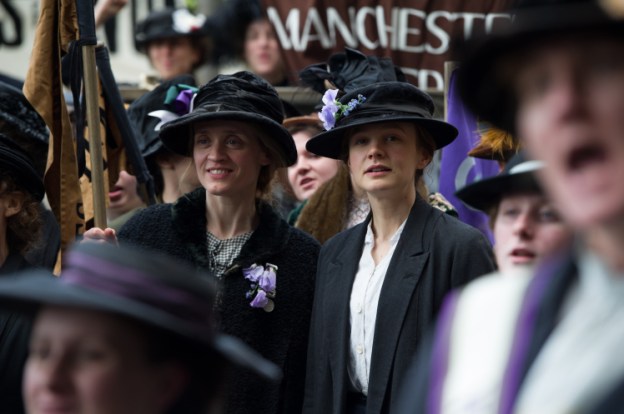
Carey Mulligan is radiant and soulful in “Suffragette,” playing a turn-of-the-century working class Londoner who rises at dawn to see her small son off to day care so she can put in long, punishing hours at a fume-filled laundry.

The factory’s sleazy foreman treats Maude Watts better than the other girls, but there’s a price to be paid for his favor, as we eventually discover.

Later, Maude heads home to her one-room flat to make tea for her husband (Ben Whishaw, aka James Bond’s Q) and little boy (Adam Michael Dodd), then tends to her own washing before climbing into bed so she can face another thankless day.

If nothing else, “Suffragette” will make you eternally grateful you’re not a turn-of-the-century working class Londoner, especially a female one.

If the drama doesn’t offer much else in the way of inspiration that’s no fault of Mulligan’s. The actor brings Maude’s transformation from downtrodden worker bee to stoic foot soldier of a revolution to light in a way that writer Abi Morgan’s screenplay does not.

There’s a scene early on in which Mulligan’s Maude finds herself reluctantly testifying before Parliament about the working conditions she endures. When the statesman conducting the interviews asks her what the vote would mean to her, a look of bewilderment flits across her face, followed by a hope so tentative it breaks the heart.

At that moment, Maude imagines another life for herself, and we feel every lovely, aching shift in her awakening, her giddiness at having discovered her voice.

Therein lies the beauty of Mulligan’s performance. Maude’s journey to self-realization or radicalization, or whatever you want to call it, becomes something we can accept and emotionally invest in, despite the gaping holes the script leaves in its heroine’s emotional life.

Ushered into the suffrage movement by a feisty co-worker (Anne Marie-Duff), Maude stumbles onto rowdy protests and acts of civil disobedience, landing in prison, almost by accident, and out of her husband’s good graces.

Morgan and director Sarah Gavron don’t build a case for why Maude would let slip her strong, affectionate hold on her child, who must be the most adorable little boy in England. And yet, there she is, scrubbing angrily at her finger with a bar of soap to pry away her wedding ring, thereby relinquishing her maternal rights.

All this to join a band of outcasts who throw rocks through shop windows, blow up post boxes, and meet clandestine in chapels and crypts to plan further acts of rebellion at the behest of revered activist Emmeline Pankhurst.

The beloved Mrs. Pankhurst is played by Meryl Streep, who delivers a rousing speech from a balcony window while the police close in.

It’s a shame that this is Ms. Streep’s only appearance for “Suffragette” could use more of her ebullient spirit. The film is a mostly dreary affair, almost an academic exercise.

Gavron and Morgan run down the check list of indignities suffered by the women who agitated tirelessly for the right to vote, from abuse at home, to public humiliation, to harassment, beatings and force feedings by unsympathetic coppers (including Brendan Gleeson as the humorless Inspector Steed).

Characters of all classes and personalities — including a courageous chemist played by Helena Bonham Carter — come out of the woodwork to give their testimonies for the cause, but their sacrifices feel like the stuff of cinematic sentiment more than bleeding casualties of war.

And though there must have been men who were at least a bit sympathetic to the cause, you wouldn’t know it from the array of villainous males who march stoically through nearly every frame of “Suffragette.”

For all my criticism, I’d be tempted, if I had the power, to make the movie mandatory viewing for all women who find themselves on the fence when it comes to feminism.

As an alarming backlash against gender equality seems to be gathering ominously on the pop cultural horizon, like the dark clouds of some apocalyptic storm, it’s a valuable thing to be reminded that without these glorious early crusaders for women’s rights, we wouldn’t have the luxury of denying what they fought for.

Photo: metro.co.uk.

Fassbender an Insufferable, Strangely Sexy Steve Jobs

Steve Jobs
Three stars (out of four)
R (language)
122 minutes

The brilliant inventor of sleekly designed, user friendly gadgets that revolutionized the way the world thinks about computers was a poorly made machine, incapable of love, kindness, selflessness or even basic human decency.

That’s the thesis of “Steve Jobs,” Danny Boyle’s fascinating, if flawed, expedition into the volatile mind of the late genius who co-founded Apple and made it possible for many of us to enter into a passionate, co-dependent relationship with our iPhones.

(Oh, precious iPhone, how do I love thee? Let me count the ways.)

(Ahem. Sorry.)

Boyle’s film benefits greatly from a whip-smart script by that maestro of intelligent, playful dialogue, Aaron Sorkin, and by the fact that it is 10 times bolder, more ambitious and more absorbing than the 2013 Jobs biopic starring Ashton Kutcher.

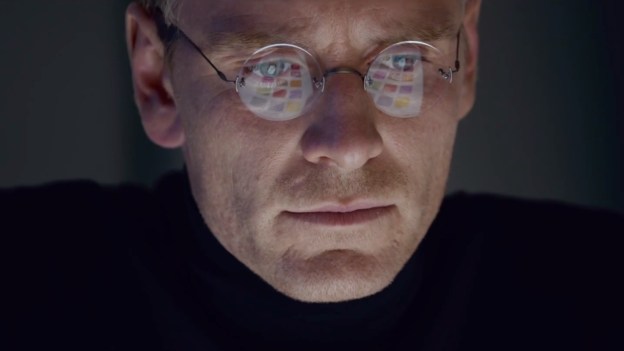
At the center of the movie is a mesmerizing, maniacal performance by Michael Fassbender, who seemed an odd choice to portray one of the geekiest innovators of all time.

Fassbender is a marvelous actor, but he oozes sex appeal and a shark-like menace not typically associated with a man famous for his spectacles, white sneakers, mom jeans and black turtleneck. I’ll admit I was extremely skeptical going into “Steve Jobs” that the fiery, Irish star of “Shame” and “Twelve Years a Slave” could pull this off. The crazy thing is how well this unlikely casting choice works.

Fassbender’s intensity, his gift for plumbing the depths of tortured souls and, yes, even the more seductive qualities that have made him quite popular with the ladies combine to create the perfect embodiment of Sorkin’s Jobs, who is — not to mince words — a monumental douchebag.

Yet, he’s a douchebag who radiates a strange, irresistible charisma. We hate this guy. We really do. But we’re also strangely drawn to him.

Fassbender also shares an electric chemistry with co-star Kate Winslet, who plays Jobs’ long-suffering longtime confidante, Apple marketing exec Joanna Hoffman. She’s so good, you’ll forgive her inconsistent Polish accent.

“Steve Jobs” is basically Steve and Joanna’s bizarre love story, albeit a platonic one.

“Why have we never slept together?,” Jobs asks Hoffman in one typically Sorkinesque scene.

“Because we’re not in love,” Hoffman snaps, all business.

If you sat through the dull and plodding 2013 Jobs biopic then you’ll recognize it as no small mercy that Boyle and Sorkin have hit upon a refreshingly innovative structure for their version of Steve’s story.

“Steve Jobs” unfolds in three acts, each of them set in the hours before a big product launch. Ever the edgy stylist, Boyle stages each one in a different cinematic format to reflect the passing of technological eras — the first in low-tech 16 mm film, the second in shiny 35 mm, the finale in coolly detached digital.

The film has the minimalist, intimate, talk-heavy feel of a play. It’s also very similar to Sorkin’s script for “The Social Network,” wielding a veritable hatchet at Jobs’ character in a portrayal that may or may not be fair but is utterly hypnotizing to watch.

Our first impression of Jobs is anything but favorable as he juggles familial and professional responsibilities behind the scenes of the 1984 unveiling of the first Macintosh computer.

While Jobs obsesses over technical difficulties and the fact that he wasn’t chosen as Time magazine’s Man of the Year, Hoffman struggles to keep her mercurial boss focused on the tasks at hand, which include placating ex-girlfriend Chrisann Brennan (Katherine Waterston) even as he denies paternity of her precocious child, Lisa (Makenzie Moss).

Yes, Sorkin’s Jobs is a man cold-hearted enough to proclaim his lack of parental responsibility to a 5-year-old girl’s adorable face, even after she proudly proclaims, “My Daddy named a computer after me.”

Also on Jobs’ social calendar: Software wizard Andy Hertzfeld (Michael Stuhlbarg), who Jobs humiliates because he fails to program the Mac to say “Hello”; Apple co-founder Steve Wozniak (Seth Rogen), who calls Jobs out on his refusal to acknowledge key members of the development team; and Apple CEO John Sculley (Jeff Daniels), Jobs’ father figure and future rival.

Bridges, Rogen and Stuhlbarg are all excellent, but especially Stuhlbarg, who brings such strength and sensitivity to his soft-spoken character. These three men haunt Jobs throughout the film.

Like Scrooge’s ghosts, they reappear to confront him after his messy split with Apple, at the 1988 launch of his doomed NEXT computer, and finally before his defining moment, the 1998 debut of the iMac.

Lisa is also a recurring character and Jobs’ relationship with the daughter he is so reluctant to acknowledge becomes the major emotional force in a movie that takes many factual liberties but nevertheless has a compelling ring of truth about it.

There’s an air of surrealism to the film as Sorkin and Boyle conjure up a public shouting match between Jobs and Wozniak that never actually occurred and intimate conversations with Sculley and Jobs long after the pair had in reality parted ways.

The movie’s second act is its most thrilling, depicting Jobs’ firing from Apple and his eventual triumphant return to the company as an elaborately staged coup designed to satisfy his thirst for revenge.

“Steve Jobs” can be melodramatic and heavy-handed at times — pinning down Jobs’ fear of rejection to his adoption is a bit simplistic, for instance — and it lets the character off the hook too easily in the end with a reconciliation that is entirely too sentimental for a movie this glacial.

The film’s best qualities are some of Jobs’ best qualities, too. It’s charged with friction, energy and daring vision.

Photo: http://www.musicbusinessworldwide.com.


‘Crimson Peak’ a Ravishing Gothic Romance

Crimson Peak
Three stars (out of four)
R (bloody violence, sexual content, brief strong language)
119 minutes

If you’re a fan of horror movies that scare the pants off you, “Crimson Peak” probably isn’t your cup of tea.

(Judging by the film’s dismal performance at the weekend box office, most moviegoers fall into this category.)

However, if you’re of a literary persuasion and prefer macabre tales steeped more in mood and mystery than cheap gimmicks, you might just love director Guillermo del Toro’s playful, authentic homage to beloved gothic romances including “Wuthering Heights,” “Jane Eyre,” “Rebecca,” and Mary Shelley’s “Frankenstein.”

In the film, as in life, Del Toro isn’t exactly subtle about his novel influences.

“The first movie I saw when I was four was ‘Wuthering Heights,’ and then I discovered at the same time ‘Frankenstein’ and ‘Jane Eyre.’ … And I had this immense spiritual love affair with the Brontës and Mary Shelley,” he told website The Mary Sue, instantly winning the hearts of English majors everywhere.

There’s a scene in “Crimson Peak” in which the snooty mother of a rival compares Mia Wasikowska’s naive but inquisitive heroine to Jane Austen and is quick to point out that the famed author of “Pride and Prejudice” and “Emma” died a “spinster.”

“I would prefer to be Mary Shelley,” Wasikowska replies smartly. “She died a widow.”

This snippet of dialogue isn’t simply a wink to lovers of gothic horror. It’s also a handy bit of foreshadowing in a movie that delights in both reconstructing and deconstructing the conventions of a deliciously dark and stormy genre.

As gothic romances are wont to do, “Crimson Peak” centers around a damsel — thanks to a satisfying feminist tweak by Del  Toro, she’s more determined than distressed — who falls in love with a man she hardly knows.

He sweeps her off to his creepily remote ancestral mansion, where horrible family secrets lurk around every corner and spirits literal and metaphorical prowl the halls.

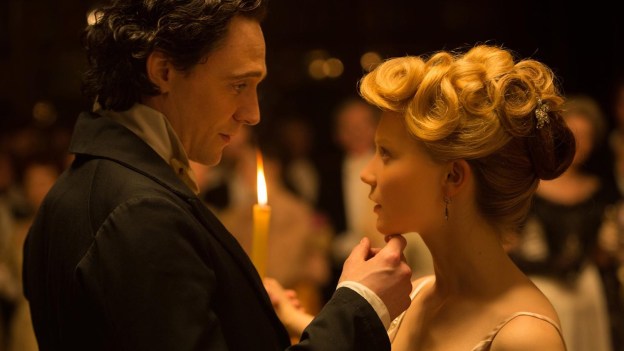
Wasikowska, who radiates strong-willed girlishness, is perfectly cast as Edith, an aspiring author of ghost stories whose first supernatural encounter occurred at age 10, shortly after the death of her mother.

Also ideally suited to his role is Tom Hiddleston, smoldering yummily in a top hat and period suit as the enigmatic Thomas Sharpe, a British aristocrat who arrives in New York with a business proposal for Edith’s wealthy father (Jim Beaver).

Failing to secure Dad’s approval, he wins the daughter’s heart instead and the newlyweds decamp to England and Allerdale Hall, the cold and gloomy residence of the mostly deceased Sharpe clan.

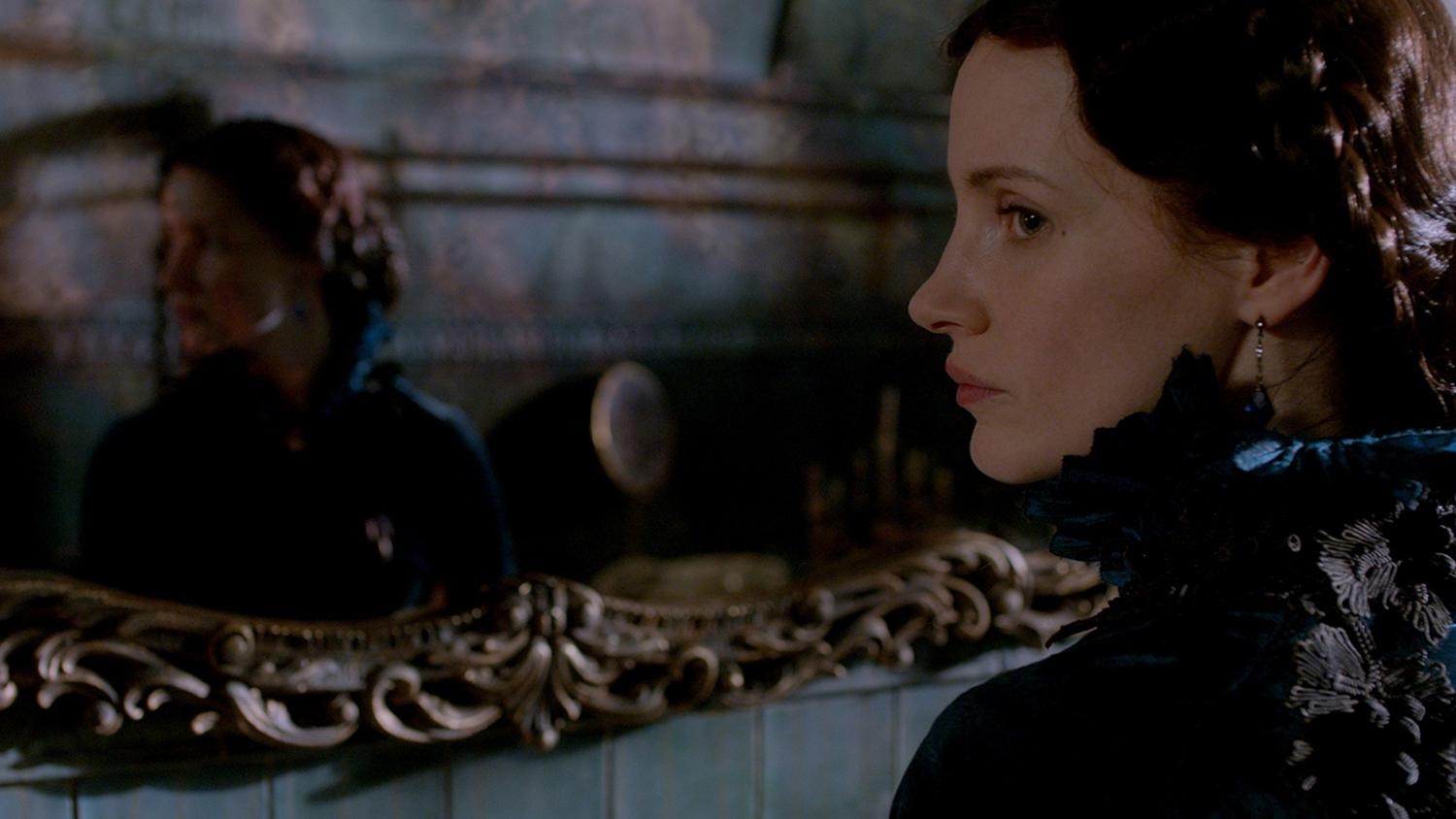
Despite the fact that the walls ooze blood-red clay and there’s a freakin’ hole in the ceiling, through which crisp, autumn leaves artfully flutter, Edith strives to settle into her new home, ever under the sharp, prying gaze of Thomas’ passive-aggressive sister, Lucille (Jessica Chastain, her ginger locks died a morbid jet black).

crimson-peak-11-2

As Thomas’ attentive sibling, Chastain is having way too much fun peeping through keyholes, abruptly materializing in doorways, clutching a jangly set of tempting house keys, and warning Edith not to descend too far into the bowels of the mansion in a rickety elevator that seems to have a mind of its own.

Edith has hardly set foot in the place when she begins to make unwitting contact with Allerdale’s other residents, including inky specters who pop up just in time to spoil a nice, hot bath or soothing cup of tea (many of them played in motion capture by Del Toro’s frequent collaborator, Doug Jones).

The audience will chuckle at Edith’s stubborn nonchalance, even as the very fabric between earth and hell seems to be unraveling along with her health. But this, my friends, is model behavior for a classic gothic heroine and is as fun to watch as it is maddening, along with all the other trappings of the genre.

I wish Del Toro and co-writer Matthew Robbins had spent more effort obscuring a mystery that’s a little too quickly solved and pretty early on too. Since “Crimson Peak” focuses more on story than intense scares, it would be nice if the narrative had a few additional twists and turns, if it was more “Pan’s Labyrinth” than “Don’t Be Afraid of the Dark.”

There’s no lack of entertainment, though, in watching this very game cast play out their grisly roles with twisted passion. And it helps that “Crimson Peak” is ravishing to look at, thanks to the director’s signature attention to detail and opulently gory production design.

From the exquisite puff-sleeved Victorian ball gowns, to the dapper top hats, to the bleeding wood-and-melted-wax skeleton that is Allerdale Hall, the film is aflame with glorious costume-drama bedazzlement.

It won’t keep you up at night, but it’s a juicy bedtime story anyway.

Photos: http://www.digitaltrends.com

‘Everest’: Lost in a Blizzard of Unanswered Questions

Everest
Two and a half stars (out of four)
PG-13 (intense peril, disturbing images)
121 minutes

Why are some humans born with a suicidal impulse to defy the limitations of what is naturally possible? To traverse strange oceans in search of new continents? To rocket into outer space? To push a body to the brink of death on the summit of the world’s highest mountain?

You won’t find more than pat answers to this question in “Everest,” a reenactment of the ill-fated 1996 expedition that became the subject of John Krakauer’s book, “Into Thin Air.” (The film moved into wide release Friday after a limited debut in IMAX theaters.)

“Everest” isn’t based on Krakauer’s best-selling account — the author recently slammed the movie as “total bull” — although he is depicted as a character in the film, played by Michael Kelly of “House of Cards.”

Writers William Nicholson (“Unbroken”) and Simon Beaufoy (“127 Hours”) based their script on various sources, conducting their own research into one of the deadliest incidents in Everest’s history. The film is well acted and technically impressive — especially in soaring, rumbling IMAX — but lacks a definitive point of view, perhaps in an attempt not to point fingers or take sides,

The absence of a singular perspective results in a frustratingly vague cinematic experience. The confusion is compounded by the fact that the actors portraying the film’s ensemble of unlucky climbers are often obscured by oxygen masks, goggles and hoods, making it difficult to distinguish between them in many scenes.

Keira Knightley, as the pregnant and anxious wife of one of the doomed mountaineers, and Emily Watson, as a motherly base camp manager, remain goggle-less, not to mention snug and dry in cozy sweaters, as they lend emotional support in a handful of teary-eyed scenes.

Icelandic director Baltasar Kormakur has recruited an excellent cast to piece together the puzzle of went what so dreadfully wrong during that infamous two-day period in May ’96.

After a pair of lackluster performances in the equally lackluster “Dawn of the Planet of the Apes” and “Terminator Genisys,” I had all but given up on Jason Clarke, who stars here as Rob Hall, an expert mountaineer from New Zealand whose company, Adventure Consultants, ferries even the unlikeliest of amateur climbers safely to and from Everest’s summit.

Hall is as close as the film gets to a main character and Clarke portrays him as an all-around decent guy, an interpretation that could have been unbearably cheesy in the hands of a lesser actor. Instead, we just really like this guy.

The guide is preparing to shepherd a group of amateurs of varying experience levels who have paid him $65,000 a piece to turn their dreams of reaching the summit into reality. Kormakur takes his time introducing the members of this ragtag group as they hobnob at base camp.

Among them are Yasuko Namba (Naoko Mori), a seasoned adventurer looking to notch her seventh major summit; Beck Weathers (Josh Brolin), a doctor from Texas who has the jitters but later reveals himself to be one of the toughest s.o.b.s alive; Doug Hansen (John Hawkes), a mailman desperate to complete his second attempt at the summit; and Krakauer, a journalist whose coveted media presence produces some performance anxiety in Hall and his crew.

According to the film, Hall’s success inspired dozens of imitators, leading to a commercial boom on Everest in the late ’90s. With hundreds of climbers jockeying for position as they vie to reach the summit during rare windows of good weather, a spirit of reckless competition prevails.

In the movie, this potentially dangerous development is embodied by a friendly rivalry between Hall and competitor Scott Fischer (Jake Gyllenhaal), a laid-back American who sports a carefree man bun, sunbathes half naked at base camp, and warms up at night by guzzling hard liquor straight from the bottle.

Gyllenhaal’s fictionalized take on Fischer is one of the film’s more colorful elements, but due to clumsy editing and/or a lack of time, the fate of the party-hearty American remains frustratingly obscure. This is clearly a man who knew what he was doing, so some of his more questionable decisions don’t add up.

There are many other things the audience is left to guess at as the film methodically runs through the events leading up to the disaster, sparked by a bemusing mixture of human error (overcrowding, half-empty oxygen bottles, missed turn-around times), natural forces (an unexpected and devastating storm), and cruel coincidence, whereby experienced mountaineers perished helplessly while less experienced ones suddenly revived.

There’s no shortage of human drama as a husband and wife share their last conversation via radio and climbers admit they’re unwilling to forfeit their lives on the off chance they might save another. But so many questions are left unanswered, it leaves one longing for a straightforward documentary. Just the facts, please.

Filmed in the Italian Alps and on location in Nepal with a hefty budget of $65 million, “Everest” is by far the biggest project tackled by Kormakur (“2 Guns”). On a technical level, it’s a formidable achievement. The film’s depiction of life at base camp and beyond and of the harrowing challenges encountered by those brave, or foolhardy enough, to attempt the summit feels authentic, while vertigo-inducing shots of rickety ladders traversing gaping crevasses put the audience smack in the middle of Everest’s ruthless, bitterly cold environment.

The large-screen format ensures moviegoers experience everything, from the thunderous vibration of of an avalanche to the violent frenzy of a snowstorm, deep in their bones.

Kormakur vividly illustrates the excruciating physical hardships suffered by climbers — frostbite, altitude sickness, snow blindness, cerebral edema — even on the simpler expeditions designed to acclimatize their bodies to thin air and frigid temperatures.

It takes almost until the movie’s third act for the really gripping suspense to kick in, but it finally does and with gusto. A tenuous helicopter rescue is a particularly white-knuckle moment.

What “Everest” is missing, though, is the bravura precision of someone like Paul Greengrass, director of “Captain Phillips,” “United 93,” and “Bloody Sunday.”

In re-creating some of the great tragedies and near-tragedies that haunt us, Greengrass employs documentarian accuracy and bold narrative license to weave the impossible illusion that we have the whole picture.

Watching “Everest,” on the other hand, is like stumbling through a blizzard of bewilderment.

To Emmy Winner Viola Davis, With Love

Dear Viola Davis,

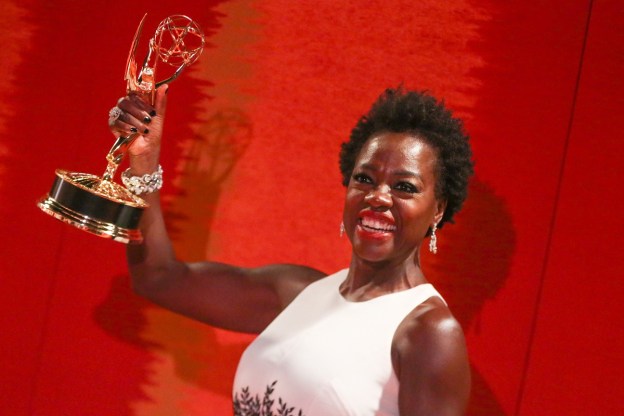
Congratulations on your historic Emmy win.

I can’t think of anyone more deserving. Every time you step in front of a camera something magical and emotionally gripping takes place.

You are one of the rare performers who always give us their very best. Even in the dreckiest of dreck, you shine. You haven’t won an Oscar yet, but it’s only a matter of time.

The Academy should have given it to you in 2009 for your supporting role in “Doubt,” a nomination you clinched in just one heart-wrenching scene.

And they should have given it to you in 2012 because, as quietly long-suffering maid Aibileen Clark, you were the raw, bleeding heart and soul of “The Help.”

Heck, they should give you an Oscar every time you show up on screen. Even in forgettable crap like “Blackhat” and “Beautiful Creatures,” you’re golden, emerging totally unscathed.

As exciting as it was to watch you become the first African American to lift up that best dramatic actress trophy, your victory speech was even more epic.

You weren’t afraid to tell it like it is: Though the television industry has taken small steps on the road to diversity, it still has miles to go.

“The only thing that separates women of color from anyone else is opportunity,” you said. “You cannot win an Emmy for roles that simply aren’t there.”

You didn’t stop there, though. Rather than end your speech on a negative note, you paid triumphant tribute to those who dare cross that line Harriet Tubman spoke of centuries ago, groundbreakers and trailblazers like Shonda Rhimes, Taraji P. Henson, and Kerry Washington.

You spoke the truth, Viola, and you did it with uncommon strength, joy and grace, the very same qualities that make you such a compelling, unparalleled actor.

I couldn’t have loved that speech more.

You know what else I love?

Your television show, “How to Get Away With Murder,” enters its second season Thursday on ABC. It’s the perfect arrangement: you continue to preside over the leading role you richly deserve and every week viewers get to enjoy your genius.

I love that your next major film is the comic book movie “Suicide Squad,” in which you play boss-of-everybody Amanda Waller. I’m more excited about that than I am about seeing Margot Robbie as the deranged Harley Quinn or Jared Leto as a terrifyingly punk-rock Joker.

I adore the fact that this is what you told the Hollywood Reporter when they asked why you agreed to appear as Waller:

“As a comic book and Wonder Woman fan, I love the whole DC Comics universe. I traded comic books as a kid so all of that appeals to me. When you dream about being an actor as a kid, that’s what you dream about. That’s like play acting: being the superhero, getting the gun; it plays into that fantasy.”

You may be an Emmy winner, a Tony winner, and an Oscar nominee, Viola, but you’re a geek at heart, just like the rest of us.

Did I mention that I love you?

Photo: Rich Fury, Associated Press


Random Thoughts on Force Friday, Idris Elba as Bond, Other News of the Week

Some random, movie-related thoughts on the entertainment news of the week:

bb8-witb-photo_legal1

Fans, savor Force Friday

Midnight marks the arrival of “Force Friday,” the official beginning of the merchandising bonanza leading up to the Dec. 18 release of “Star Wars: Episode VII — The Force Awakens.”

If you’re one of the fans staying up late and venturing out to your local Target or other stores for the unveiling of toys, collectibles, and other tie-ins to “The Force Awakens,” I salute you. As the parent of a toddler, I value my sleep too much to join you, but I’ll be with you in spirit.

At the risk of sounding like a nostalgic grandpa — “When I was a boy, we used to walk to school in 7-foot snow drifts …” — I remember a time when there was virtually no Star Wars merchandise to be found on shelves.

I was introduced to George Lucas’ space opera at the relatively late age of 12. It was the end of the ’80s and though people remembered “Star Wars” fondly, everybody was kind of over it.

The only option for watching the trilogy was renting the movies on VHS. Few people owned VHS players or video tapes back then, so you’d most likely have to rent them.

As a passionate, young convert to the “Star Wars” universe, I would scavenge for memorabilia wherever I could. There was no Internet, no eBay, no easy way to connect with fellow collectors. My prized possessions were a “Star Wars” poster, a spiral notebook from the dollar store, and a color still of Princess Leia chained to Jabba the Hutt, discovered at a creepy Hollywood souvenir shop. That was it.

It wasn’t until the release of those infamous prequels in the late ’90s that “Star Wars” merch became readily available again. Now, of course, you can find items everywhere, from T-shirts to toys, but it wasn’t always this way.

So remember that, Star Wars fans, while you’re doing your Force Friday shopping. Savor this moment.

15236-1-1100

A cure for dismal Labor Day viewing

Speaking of the weekend, if you’re planning to see a movie over the Labor Day holiday, there aren’t many options. We’re in the thick of the end-of-summer doldrums and it’s looking pretty depressing out there.

Unless you want to sit through yet another mediocre video game movie reboot (“The Transporter Refueled,” coming on the heels of “Hitman: Agent 47”), there aren’t many cinematic choices to get excited about.

My advice? Skip what’s playing at the cineplex and take this opportunity to catch up on your documentary viewing.

BLVD Cinemas in Lancaster is playing two intriguing docs this weekend: “Meru,” about climbers tackling formidable challenges in the Himalayas, and “Steve Jobs: The Man in the Machine,” from Alex Gibney, director of the provocative “Going Clear: Scientology and the Prison of Belief.”

If you’d rather stay home, some recent, critically successful titles include “Red Army,” “Citizenfour,” “Art and Craft,” “Last Days of Vietnam,” “The Salt of the Earth,” “National Gallery,” “Yves Saint Laurent,” “Whitey: United States of America v. James J. Bulger,” and “Supermensch: The Legend of Shep Gordon.”

When it comes to movies, fact is often more entertaining than fiction.

Wes Craven’s ‘Nightmare’ lives on

I was sad to hear of the passing of director Wes Craven, who died Sunday at the age of 76.

I’m a lightweight when it comes to horror flicks and though I was too much of a scaredy-cat to watch many of Craven’s movies, the filmmaker made a strong impression on me.

When I was a kid, my family often walked past the neighborhood video store, where a cardboard stand-up of Freddy Krueger peered menacingly from one of the windows. I had no idea at the time who Freddy was, but I was mesmerized by his shredded face, razor claws, and Christmas-colored sweater. I’d never seen “A Nightmare on Elm Street” and already he was haunting my dreams.

Since then, Freddy Krueger has taken his gruesome place as one of the most terrifying villains of all time. Craven also directed several other seminal and, for the time, transgressive horror films, including “The Last House on the Left” and “The Hills Have Eyes.”

In the mid-’90s, he laid the foundation for a 21st-century rebirth of horror with the “Scream” franchise, wittily deconstructing genre cliches and paying tongue-in-cheek homage to the classics. His influence can still be felt in recent horror films, like “Cabin in the Woods” and “It Follows.”

It seems Craven had ambitions to move beyond the horror genre, which despite being extremely lucrative, never earns a director much respect.

He helmed the drama “Music of the Heart,” helping star Meryl Streep to an Oscar. Though he never really moved past his role as a horror meister, his approach to his career was admirable.

“I come from a blue-collar family, and I’m just glad for the work,” Craven said in an interview quoted by the Hollywood Reporter.

“I think it is an extraordinary opportunity and gift to be able to make films in general, and to have done it for almost 40 years now is remarkable. If I have to do the rest of the films in the genre, no problem. If I’m going to be a caged bird, I’ll sing the best song I can.”

Idris-Elba

Idris Elba as Bond? Hell, yes!

The Internet has been all riled up since Anthony Horowitz, author of the latest James Bond novel, declared that British actor Idris Elba should not play 007 in a future film.

Elba’s name has long been bandied about as an ideal replacement for Daniel Craig, who is a wonderful Bond but can’t very well portray the secret agent forever. In an unfortunate turn of phrase, Horowitz said Elba was “too street” to be a convincing Bond.

Elba’s fans were outraged by the author’s statement and the insinuation that the star of “Luther” and “The Wire” isn’t suave enough to slip into Bond’s tuxedo.

I have only one question for Horowitz: Have you seen Elba?

And, more importantly, have you seen Elba act? The man is the embodiment of cool, British charm and self-possession. He oozes sex appeal, experience and the ability to inflict violence on over-the-top baddies threatening to blow up the world. And he’s a brilliant, underrated performer who deserves to finally be a leading man.

Maybe when Horowitz said Elba was “too street,” he meant that if you ask any woman — or man, for that matter — on the street who should be the next James Bond, the answer would be “yes.” (Sigh. Only in an ideal world perhaps, but still … .)

By the way, Elba’s perfectly composed Twitter response to the kerfuffle offers further proof that he is the best man for the job.

“Always keep smiling,” he said. “It takes no energy and never hurts! Learned that from The Street!”

Photos: sundance.org; o.canada.com; bbcamerica.com.


Book Review: Humor Elevates Potentially Cliche ‘Days of Awe’

Editor’s Note: I don’t have as much time as I’d like to blog about the wider pop culture spectrum and such wonderful things as books, television, music, etc. That’s why I’ve asked my friend Shawna Foxgrover, a gifted copy editor and writer, to pen the occasional guest post for lavendervroman.com. Shawna is an avid reader with witty insights on contemporary literature. Below, enjoy her first review for the blog. 

By Shawna Foxgrover

Days of Awe
By Lauren Fox
Knopf
Fiction, 272 pages

The first page of this book had me rolling my eyes. Someone has just died and our protagonist is at a funeral. How cliche. And it’s the funeral of our heroine’s best friend, Josie. I just read a best-friend-dies story about six books ago and that one was so painfully boring I never finished it.

To be fair, I had just come off a science-fiction kick when I picked up “Days of Awe,” so anything without zombies, intergalactic assassins or post-apocalyptic teenage heroes was guaranteed to make me yawn. But I soldiered on and was not disappointed.

10679942_807597812616944_7572479383960202164_o (2)

Shawna Foxgrover

Isabel Moore, the heroine of Fox’s third novel, is likable and funny, and “Days” turns out not to be a story about death after all. Fox writes Isabel, and her mother and daughter — and all her characters — to life: Mom Helene is haunted by the loss of relatives in the Holocaust. She holds onto Isabel, her only child, a bit too tightly but stops short of becoming the stereotypical overbearing, smothering Jewish mother.

Isabel’s daughter Hannah, 11, is at that age when she doesn’t fit in her mom’s embrace anymore, nor does she want to. Recalling a time when her daughter was 6, Isabel says, “It would be the blink of an eye before Hannah turned into the girl she is now, the one who disdains my affection and cringes from my touch. If I’d know then, I would have … well, what would I have done? Recorded a caress? Taken notes on a hug? You can’t preserve anything; every happy moment is already on its way to becoming nostalgia. That’s the problem.”

Fox’s narrative voice sounds so clever and familiar, I kept flipping to the front cover to look at her name again. Had I read any of her stuff before? I hadn’t. When a scene in the book reminded me of a scene in “When Harry Met Sally,” I realized she reminds me of Nora Ephron. Her writing also brings to mind Elizabeth Berg and Liane Moriarty.

At the center of “Days” is the mystery surrounding Josie’s death, which Josie’s husband claims is his fault. Isabel reassures him: “How could this be your fault? It’s not!” But then she tells us, “Of course it was his fault. And it was my fault, and possibly Chris’s, and most definitely Josie’s, and some other people’s faults too.”

The titular Days of Awe refer to the Jewish High Holy Days, Rosh Hashanah and Yom Kippur, and also sometimes are said to include the 10 days of repentance, a time during which Jews meditate on the subject of the holidays and ask for forgiveness from anyone they’ve wronged. With this in mind, we wonder if Isabel needs to be forgiven for what happened to Josie. And how was she responsible? Does she need forgiveness from her husband, from whom she is separated one year after Josie’s death? And why are they no longer together?

The story jumps around from past to present to further past and back again, but it’s (usually) easy enough to follow and the author’s subplots don’t feel like an annoyance but instead are so diverting you almost forget to be impatient for the secrets to be revealed. Anyway, this is not a plot-driven story. As Isabel obsesses about the downward spiral that led to her friend’s death, it is Isabel’s own unraveling that is under the microscope here.

The novel examines love and loyalty and all the complicated feelings we have for our children and our parents, and in our friendships and marriages, and how some of these bonds are more fragile than we realize. It sounds depressing but it’s not. Isabel’s observations and wisecracks had me chuckling every few pages and ultimately it is Fox’s sense of humor which elevates this character study into a book you won’t want to put down.

More Recommendations by Shawna

Here are a few of my recent favorites, new in paperback:

“Big Little Lies,” by Liane Moriarty: The latest novel by the Australian author is fun and accessible, as are all of her books, most of which I read one after another. This one is a sort of light-hearted murder mystery, if there is such a thing. The story is told from the viewpoints of three mothers whose children attend the same school where, on the night of a parents’ fundraising event, one of the parents in attendance ends up dead.

“The Goldfinch,” by Donna Tartt: This Pulitzer Prize-winning novel is the epic tale of the events that unfold after a teenager steals a priceless painting from a museum after it’s bombed by terrorists. It’s a beautifully written book and I loved it, but some critics groused about its length (771 pages), so if you prefer your books short and sweet, steer clear.

“The Girl With All the Gifts,” by M. R. Carey: If your tastes run more toward Stephen King, this is for you. It’s creepy as hell, but unputdownable. Don’t say I didn’t warn you (on both accounts).

Shawna Foxgrover graduated from Cal State University, Northridge, with a bachelor’s degree in English literature and worked at the Antelope Valley Press for six years before her current position as a stay-at-home/out-and-about mom to two kids and two naughty cats. She likes reading, writing and watching movies. 


Summer of Bad-Ass Ladies: The Sequel!

Last year, around this time, we saluted the women who breathed fresh air into a moviegoing season that typically reeks of testosterone.

Many of 2014’s summer blockbusters were headlined by women, including Angelina Jolie, Emily Blunt, and Scarlett Johansson — cause for celebration. There was so much awesomeness going on that we declared it the “Summer of Bad-Ass Ladies.”

Now it appears summer 2014 wasn’t a blip on Hollywood’s radar, but the beginning of a promising trend. The films of summer 2015 were packed with substantial roles for women, who effortlessly stole scenes –and, in some cases, entire movies — from their male co-stars.

(That said, annoying female stereotypes persist. Did “Jurassic World” really need to punish Bryce Dallas Howard’s Claire for loving her job too much and not being into kids?)

As we close the books on the year’s most explosive moviegoing season, it is with great delight that we dub it “Summer of Bad-Ass Ladies: The Sequel.”

Below, we revisit the baddest of these pioneering bad-asses. We hope we’ll be seeing them next summer, too.

Mad-Max-Fury-Road-final-trailer

Charlize Theron in “Mad Max: Fury Road”: For the sake of its promotional campaign, Warner Bros. pretended that Tom Hardy’s Max is the star of “Fury Road.” But if you’ve seen the film, you know it is Theron who owns virtually every frame of this magnificently bleak and beautiful post-apocalyptic action flick. With a shaved head, oily face paint and one arm, tough-as-nails truck driver Furiosa is the heart and sinew of director George Miller’s female-centric road movie, with Hardy’s Max mostly along for the ride. When it comes to sci-fi heroines, she’s right up there with Ripley and Sarah Connor.

What’s even more impressive? There isn’t a single damsel in distress to be found in “Fury Road.” The cast’s menagerie of bizarre supporting characters includes strong, resourceful women of all ages and personalities. Why should this be such a rare thing? Hollywood execs should use Miller’s forward-thinking epic as a template for all summer blockbusters to come.

ex_machina_2015_movie-wide

Alicia Vikander in “Ex Machina”: There are so many wonderful, eerie and astonishing things to discover in writer-director Alex Garland’s artificial intelligence thriller. Chief among them is Swedish performer Vikander, also delightful in “The Man From U.N.C.L.E.,” who brings to life the strikingly beautiful, eerily lifelike humanoid at the center of the film. With her cherubic face and curvaceous CGI body, Vikander’s Ava is alluring and dismaying, uncannily perfect, and completely believable. Is Ava the perfect object of male fantasies or a master manipulator? Is she a girl waiting to be rescued or a skilled self preservationist? In a film where nothing is quite what you expect it to be, Vikander is the biggest surprise of them all.

mission-impossible-rebecca-ferguson

Rebecca Ferguson in “Mission: Impossible — Rogue Nation”: Last summer, Tom Cruise starred in “Edge of Tomorrow” but willingly took a back seat to the incredibly bad-ass Emily Blunt, who dominated the clever sci-fi thriller. Weird rumors about Katie Holmes aside, maybe this guy deserves some feminist cred. This summer, he did it again, basically ceding his role as headliner of “Mission: Impossible — Rogue Nation” to intriguing newcomer Rebecca Ferguson.

As enigmatic triple agent Ilsa Faust, Ferguson matches Cruise step for step and blow for blow in executing her own stunts and when it comes to intrigue, she’s a lot more interesting than the one-dimensionally heroic Ethan Hunt. The film’s most electrifying sequence, an attempted assassination in a Vienna opera house, is almost entirely Ferguson’s show. Coolly shimmying up the rigging in the sleekest, and most practical, of silk gowns, she’s practically auditioning to take over the franchise.

feacffd963965ea49ce124f52299da89a17b6331

Melissa McCarthy in “Spy”: McCarthy has always been brilliant at satirizing social convention, but she’s so likable and so good at what she does, we hardly notice the sly statements she makes. In “Spy,” she reunites with “Bridesmaids” director Paul Feig and tackles the male-dominated genre made famous by James Bond and Jason Bourne, playing a timid CIA analyst lured out from behind her desk and into the dangerous field.

McCarthy may be may be sending up the exotic, over-the-top world of Hollywood espionage, but she also has a lot of fun and gets to do everything 007 does — a moped chase in Budapest, a killer knife fight — only she’s way more hilarious.

background

Elizabeth Olsen in “Avengers: Age of Ultron”: When it comes to creating memorable on-screen superheroines, Marvel has been a bit slow to evolve. Scarlett Johansson’s Black Widow is a formidable force but is seriously outnumbered by her male colleagues, who don’t have to stuff themselves into a slinky, black catsuit before saving the world. So it was a welcome moment when Olsen’s otherworldly Scarlet Witch made the scene in “Age of Ultron,” wielding some very cool telekinetic abilities. You can see just see the neighborhood kids mimicking her witchy powers of mind control while playing superhero. That’s something long overdue.

maxresdefault

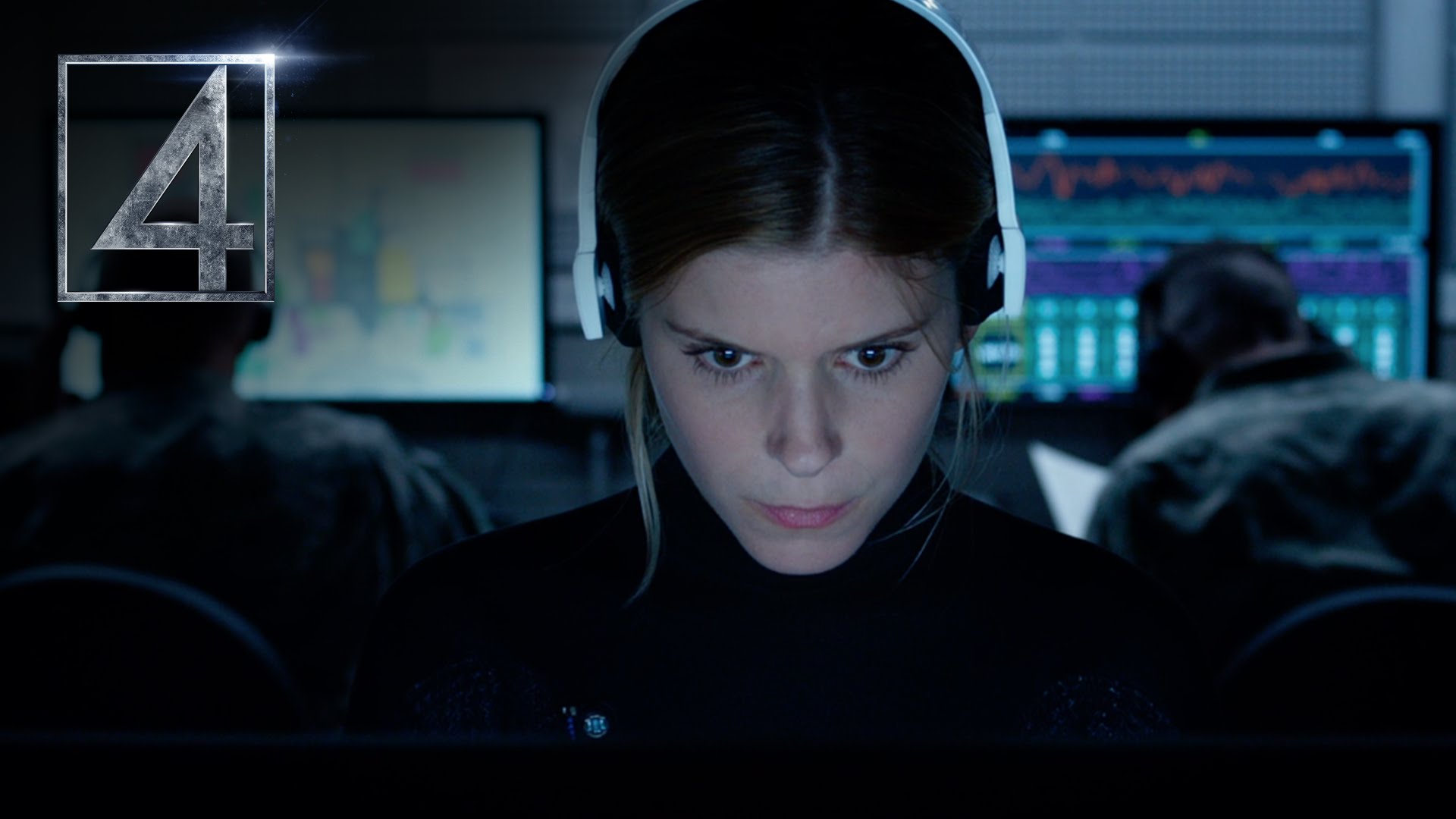
Kate Mara in “Fantastic Four”: Comic book movie reboot “Fantastic Four” took a critical and fiscal bruising when it debuted earlier this month. The film is widely considered a disaster but it contains at least one overlooked element: Mara’s thoughtful portrayal of invisible woman Sue Storm. Watching the actor at work, it’s hard to believe that only 10 years ago, Jessica Alba’s Sue was largely celebrated for the way she filled out her skintight suit. In sharp contrast, Mara’s performance emphasizes Sue’s brains over her body. She is arguably the first female superhero whose intellect is more important than her sex appeal.

Photos: http://www.techinsider.io; http://www.youtube.com; marvel.com; tribecafilm.com, http://www.zimbio.com.

Fantastic Four Isn’t Great, But It’s Not the Disaster Everyone Says It Is

Fantastic Four
Two stars (out of four)
PG-13 (sci-fi action violence, language)
100 minutes

I find myself in the odd position of defending “Fantastic Four,” a film that received a dismal 9% rating on Rotten Tomatoes and delivered one of the worst box office performances ever for a movie associated with the lucrative Marvel brand.

Critics spent the last week and a half kicking this ill fated reboot while it’s down, and while I can’t say I blame them, the degree of gleeful vitriol directed at the film seems excessive to me.

“Fantastic Four” fails on many levels. Even in its best moments, it mostly doesn’t work. But what critics are overlooking is that director Josh Trank has taken a radically different approach to a comic book movie formula so worn, it’s becoming positively threadbare.

“Fantastic Four” is Trank’s weird but fascinating mad science experiment gone wrong. The director’s approach to one of comic book history’s most flamboyant franchises is so understated, it’s almost somnambulistic, but there’s something about the rubbed-rawness of it that is the perfect antidote to the hot-buttered-popcorn pageantry of movies like “Iron Man,” “Thor” and “The Avengers.”

Yes, there are all kinds of problems with the film, from an unpolished script that often reads like a first draft to its half-hearted, muddy-looking visual effects, but one gets the sense “Fantastic Four” could have been great. If Twentieth Century Fox is stubborn enough to forge ahead with a sequel, they may be onto something.

Trank’s career is most likely over. Whether Fox’s meddling or his inexperience are to blame for this is the subject of debate. Earlier this year, the director did the unthinkable and walked away from a Star Wars “anthology” film, a move that probably wasn’t his idea.

This is sad because Trank’s 2012 debut, “Chronicle,” showcases a talent for putting an original, realistic spin on the cliche comic book origin story. A drama about high school buddies who suddenly acquire superpowers, it clearly inspired the first act of “Fantastic Four,” which kicks off with the blossoming of an unlikely grade-school friendship between science nerd Reed Richards and street-smart Ben Grimm. (They’re played as adults by Miles Teller and Jamie Bell.)

Grimm’s family conveniently owns a scrapyard full of the parts Reed needs to complete his pet science project, a teleportation device, and Ben is just curious enough about his strange, little friend’s wacky ideas to go along with him.

The pair debut Reed’s creation at a high school science fair, attracting the attention of Franklin Storm (Reg E. Cathey), a philanthropist researcher who has been working in vain on the same technology.

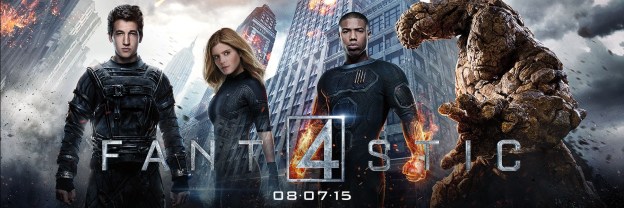
Storm offers Reed a scholarship to his scientific institute, where he’s recruited a team of young geniuses, including his children, brilliant Sue (Kate Mara) and irresponsible Johnny (Michael B. Jordan), along with Storm’s former protege, Victor Von Doom (Toby Kebell), a brooding computer prodigy.

The first act of “Fantastic Four” focuses on the meeting of these eager, young minds and it isn’t half bad. This is largely due to the efforts of the film’s eager, young stars, who in previous roles have proven themselves to be incredibly gifted.

(Kudos, especially, to Mara, who may be the first woman in Hollywood to embody her superheroine with more regard for intellect than sex appeal.)

Unfortunately, the script does these promising performers a disservice. Penned by Trank, Jeremy Slater and “X-Men” scribe Simon Kinberg, the screenplay is in dire need of a few more drafts. Characters are left undeveloped, the pacing is out of joint, key scenes seem to have gone missing, the dialogue turns awkward, conflicts are hinted at but never fully materialize.

The scenario that imbues our quintet of heroes with powers that dramatically alter their body chemistries is as ridiculous as it is horrifying.

Yes, the way things go down in a fourth dimension dubbed “Planet Zero” is wildly insulting to the audience, but it also provides a brief glimpse into what a gloriously twisted thriller “Fantastic Four” could have been, dipping into Cronenbergian nightmares as our quartet of newly initiated heroes confront the terror of their freakishly transformed physiques, including super-stretchy limbs, invisibility, and involuntary combustion.

In sharp contrast to the cartoony 2005 film starring Chris Evans and Jessica Alba, Trank actually downplays the more over-the-top qualities of the Fantastic Foursome’s abilities. This counter-intuitive choice ultimately hurts the film — poor Jaime Bell suffers most as rock monster The Thing languishes in the background — but I have to admire how gutsily polar opposite Trank’s “Fantastic Four” movie is from the “Fantastic Four” movie we expect.

Also daring, and kinda dumb for filmmakers catering to comic book lovers who generally want to see their superheroes put the smack down: There is only one major action setpiece in the film, and it comes at the end, and it is a complete mess

Once again, some may see the absence of the genre’s trademark POW!, BANG!, BAM! moments as a flaw, and if box office is what you’re concerned about, that’s a pretty big flaw.

Maybe I’m crazy, but I can’t help but wonder: Could there be a place for a comic book movie that doesn’t offer “Avengers”-style mayhem and destruction roughly every 10 minutes?

Charlie Jane Anders of io9.com declares that “Fantastic Four” is “the most self- loathing superhero movie I’ve ever seen.”

“The new ‘Fantastic Four’ reboot goes beyond darkness, into actual self-loathing,” she writes. “It’s kind of bizarre. … This movie’s central storyline is less a plot, and more a shame spiral.

I think Anders inadvertently pinpoints what is good about “Fantastic Four.”

Why shouldn’t a comic book movie be about shame instead of shallow spectacle? Self-loathing instead of shiny spandex?

Why shouldn’t it push “beyond darkness” into emotional territory that isn’t bizarre so much as it is realistic and even deeply uncomfortable?

Perhaps reviewers are circling “Fantastic Four” like a pack of sharks after a sardine because they don’t know what to make of it.

Photo: sciencefiction.com