Godzilla Review — Giant Lizard: 1, Humans: 0 in Monster Movie Reboot

Godzilla
Two and a half stars (out of four)
Rating R (intense sequences of destruction, mayhem and creature violence)
123 minutes

Godzilla makes a welcome return in an update by director Gareth Edwards, but despite the film’s impressive visual effects, the giant lizard of Japanese lore too often takes a back seat to a bunch of boring humans.

Edwards got the job on the merits of 2010’s “Monsters,” an alien invasion flick that conjured up convincing sci-fi beasties on a small budget. That film was satisfyingly character driven with the extraterrestrials serving as a backdrop for human drama. The same cannot be said for “Godzilla,” which features frustratingly passive homo sapiens and sporadic thrills, thanks to some massive monster mash-ups.

Yes, that’s mash-ups plural. In this latest version of “Godzilla,” more than one primordial predator prowls the U.S. — or a large swath of Nevada and California, anyway — squashing skyscrapers underfoot as if they were bugs. To say more would spoil the surprise.

The movie begins with a long, exposition heavy introduction, circa 1999, as a pair of anxious scientists, played by Ken Watanabe and Sally Hawkins, investigate a mysterious underground phenomenon in the Philippines. Could the radioactive spores uncovered during a mining operation be connected to a disaster at a Japanese nuclear power plant? You bet Bryan Cranston’s wig they are!

A panicked and manic Cranston plays Joe Brady, an engineer who survives the meltdown, but remains scarred for life. Fifteen years later, he is still trying to prove the incident wasn’t just the aftermath of seismic tremors. His crazy conspiracy theories get him into trouble, forcing his grown son, Ford (Aaron Taylor-Johnson), to leave his wife (Elizabeth Olsen) and child (Carson Bolde) and jet off to Japan to bail him out.

Meanwhile, the military — headed up by poor David Strathairn’s stressed-out admiral — launches an inept defense against the ancient behemoths as they ravage one major city after another, lured by the radiation they thrive upon. Strathairn is concerned about civilian casualties while Watanabe’s monster-loving scientist sagely admonishes, “Let them fight!”

Edwards is going for the slow build here, taking his sweet time before revealing the first image of the mythical creature we’ve all come to the cineplex to see, a suspense-ratcheting approach that worked beautifully in venerable monster romps such as “Alien” and “Jaws.”

The director capitalizes on brief glimpses of Godzilla’s primordial spines arching out of the water, but an excellent cast urgently intoning dull dialogue about electromagnetic pulses and the balance of nature proves a poor substitute for the movie’s massive, scaly main attraction.

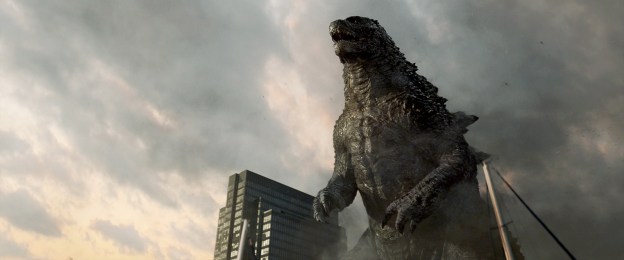
When Godzilla finally does make his official entrance, he doesn’t disappoint. There’s something classic about Edwards’ interpretation of the gargantuan radioactive reptile that harkens back to the beast’s creature-feature debut in 1954’s “Gojira.” The sight of his hulking, craggy frame emerging from San Francisco Bay, inch by inch until he unleashes a mighty roar, is startling but also comfortingly familiar. With its larger-than-life scale and rumbling sound, IMAX 3-D is the appropriate medium in which to  revisit this beloved monster movie icon.

Max Borenstein and David Callaham’s script is far more interested in its eponymous titan than in the puny actors who spend their time gawking, awestruck, at the magnificent beast. Taylor-Johnson and Olsen are promising performers, but they have never been so bland as in this movie, which literally gives them nothing to do.

In a series of ridiculous coincidences, Taylor-Johnson’s Navy bomb specialist merely happens to be in the wrong place at the wrong time over and over again, from Godzilla’s epic, tidal-wave inducing stomp-fest in Honolulu to the lizard’s final, concrete-smooshing stand in San Francisco. Occasionally, Ford threatens to actually save someone, like his family or a lost little boy, but the situation inevitably resolves itself, deus ex machina.

Edwards is at his best when he abandons his human players in favor of his colossal, computer-generated stars. The director gives us an eye witness view of the creatures so we ogle them through the windshield of a car, the rain-streaked window of a skyscraper or a paratrooper’s steamed-up goggles. This fresh perspective and a gritty knack for effects that feel tactile and realistic ensure this new “Godzilla” never becomes the joke that Roland Emmerich’s 1998 reboot was.

The 2014 “Godzilla” doesn’t dwell on the sort of over-the-top, mindless destruction that Emmerich is notorious for, but it occasionally traffics in the same cheap tricks, like scenes of children and dogs in peril. It also has a tendency to take itself too seriously.

Critics can snipe all they want about last summer’s Kaiju smackdown, “Pacific Rim,” which inspired Edwards’ reboot but underperformed at the box office. When it came to colossal critter carnage, that movie really knew how to have fun.

Photo: Warner Bros.

Some Good Things Should Come to an End, Even the Batsuit

Zack Snyder continued his efforts to blow up the Internet Tuesday by revealing the first glimpse of “Batman vs. Superman” star Ben Affleck wearing the latest incarnation of the Batsuit.

The Gotham Knight’s new duds are gritty and gray, as if they were carved out of stone, clinging to Affleck’s musculature like a second skin. It’s a marked departure from the heavy body armor that characterized Batsuits of the past and everyone breathed a sigh of relief that there were no Joel Schumacher-style nipples to be seen.

Pardon me, though, if I can’t muster up too much excitement about Batman’s latest costume change. From the days when Adam West donned purple tights to Christian Bale’s brooding interpretation, there have been no less than five major incarnations of the Batsuit with countless variations in between as one franchise gave way to another.

As a kid, I was a fan of West’s corny comic book shtick. I still have a fondness for Michael Keaton’s unconventional take on the character in Tim Burton’s stylized stab at the franchise. Schumacher’s attempts were unfortunate but I’ll admit I kinda dug Val Kilmer’s return to the less self-serious Batman of West’s era. I definitely loved what director Christopher Nolan did to mature the comic book movie with the Dark Knight trilogy.

Batman has always been one of my favorite superheroes but since 1966 there have been eight feature films centered on Gotham’s savior. I know other fans might not feel the same way, but I’m tired. I need a break. I’m not ready to invest my time and energy in yet another reboot, even if it is actually a thinly veiled Justice League movie.

A similar feeling of weariness overtook me Tuesday with the announcement of a release date for the upcoming Harry Potter spin-off, “Fantastic Beasts and Where to Find Them.” The first in a planned series of new films, it will debut Nov. 18, 2016, with a much anticipated script by author J.K. Rowling.

Am I the only Harry Potter enthusiast who doesn’t crave another adventure in Rowling’s world of wizards and Muggles? Few book series have captured my imagination as this one did but I can’t think of a more perfect finale than the one Rowling delivered with Book Seven. The ensuing movie adaptations by Warner Bros. were wildly enjoyable as well and when that franchise came to an end with “Harry Potter and the Deathly Hallows: Part 2,” it was a cathartic farewell to the boy who lived and the hours upon hours of joy he brought me. I’m so satisfied, I don’t feel the need to revisit Rowling’s universe.

I’m not saying all sequels, reboots, remakes and “reimaginings” are a bad idea. We’re a society programmed to demand more and more of a good thing with our giant SUVs, super-sized fast-food meals and endless cycles of entertainment on multiple screens. Hollywood is only too happy to feed that obsession, especially if it means making millions by recycling something they already know will work instead of taking a risk on something original.

Director Peter Jackson has taken this philosophy to an extreme and I don’t mean that as a criticism. His “Lord of the Rings” and “Hobbit” trilogies were born out of genuine passion for J.R.R. Tolkien’s fantasy masterpieces and the resulting films are mostly stunning, although it’s difficult to understand why the filmmaker feels the need to stretch each installment to interminable lengths. The studio is all too happy to rake in millions with each entry of “The Hobbit,” but Jackson could have quite easily crafted one tightly structured, beautifully executed film instead of three sprawling, sometimes tedious movies.

Must we really sit through yet another “Terminator” reboot when the last one, 2009’s “Terminator Salvation,” was at best forgettable, at worst a flop? And speaking of people who don’t know when to make a grateful exit, “Terminator” star Arnold Schwarzenegger keeps trying and failing to resurrect a movie career no one else but him is interested in reviving.

Does our world need five “Twilight” movies and four adaptations apiece of “The Hunger Games” and “Divergent” when the book series could barely sustain themselves to their final chapters?

Must every Pixar movie now have a sequel? Just remember, for every “Toy Story 3” there’s bound to be a “Cars 2.”

Of course, we all want more of a good thing but is it worth it to keep flogging a champion horse when we know at some point it will start to limp before eventually collapsing into a sad, dead heap?

I’ve already expressed my reservations about the new “Star Wars” trilogy in a previous blog post, but George Lucas’ ill-advised prequels are still my best argument against reopening a book that should have been left closed. If something is beautiful and perfect and perfectly complete unto itself, why poke it and prod it and struggle to jolt it back to life?

There is some evidence that Hollywood’s more is more approach isn’t always the best one. Earlier this month, “The Amazing Spider-Man 2” opened to a $92 million box office haul, which isn’t too shabby but is considered a disappointment compared to other movies featuring the web-slinging hero. Box Office Mojo attributed its decent but less than stunning reception to “franchise fatigue,” noting audiences seem to be tiring of Spidey’s constant presence at the cineplex.

I confess I haven’t bothered to make the trip to the theater to see “The Amazing Spider-Man 2.” Andrew Garfield and Emma Stone were charming in the first installment of director Marc Webb’s reboot but I couldn’t shake the feeling of déjà vu that hung over the entire affair. I felt like I had seen pretty much the same thing before, and recently, which I had, courtesy of Tobey Maguire and director Sam Raimi.

I think it’s time we faced the fact that some good things should come to an end. Many fans will doubtless disagree. They’re so enthralled with a beloved show, or movie, or book that they want it to go on and on forever. But even if Disney and Lucasfilm never made another “Star Wars” film, we’d still have the original trilogy. The Harry Potter books still exist. They’re on the shelf, waiting to be reread. We don’t need more movies for Rowling’s world to continue to expand within our imaginations.

Sure, there is a place for sequels to stories rich enough to continue and if someone has a good idea for rebooting an existing property, so be it, but we don’t need multiple installments of every wonderful thing.

Otherwise, we may not have the time or energy to discover the next original good thing.


Up All Night With Turner Classic Movies

Being a movie critic is the best job in the world. You get paid to watch films and, even better, to discuss them endlessly in a running dialogue with readers. I would never complain about the best job in the world, but it does have a down side. Keeping up with the latest releases, in theaters and on DVD, is an enormous, time-sucking task, so I rarely had the opportunity to go back and revisit old favorites.

As a kid, I was a voracious consumer of classic film. My tastes were cultivated by parents who weren’t afraid of movies shot in black and white or made before the ’80s. My grandmother would call us to her room to watch musicals like “My Fair Lady,” “Singin’ in the Rain” and that charming duo, Ginger Rogers and Fred Astaire. The result was that my little brother became obsessed with tuxedos, my parents were forced to listen to our renditions of show tunes on a loop during car trips and my siblings and I developed an enduring love for the classics.

That love never disappeared but it diminished during the 13 years I spent as film critic for a local newspaper. Sitting down and revisiting a gem made more than 30 years ago was a luxury of time I could rarely afford. Sometimes I’d fantasize that my boss would insist I take a year-long sabbatical to do nothing but watch Turner Classic Movies. That never happened while I was at the paper, but the fantasy did come true in an unexpected way.

At the end of December, I had a baby, a daughter who, as most infants do, required constant care through the wee hours of the night. As a new parent, I was subjected to a level of sleep deprivation so intense it made my head spin. Since my husband was working to keep that little mouth fed, I was on night shift and, let me tell you, those were some long nights. As any insomniac knows, there is no loneliness as profound as the loneliness of being awake after 2 a.m. As delightful as my new baby was, as I sat with her in my arms in the darkened living room, it was all too easy to cave in to the enveloping blackness, a despair that the morning would never come. I felt like I was the only person left in the world.

When I remembered Turner Classic Movies, the cable channel that shows vintage flicks all day and all night, a light broke through the gloom. My husband was bemused to see our DVR fill up with 1930s screwball comedies, war pictures and Westerns, Technicolor musicals, black and white melodramas, cheesy sci-fi oddities and legendary foreign films from the 1960s and ’70s — whatever struck my fancy when I stood at 4 a.m., blinking bleary-eyed at the television screen.

Hosts Robert Osborne and Ben Mankiewicz became my best friends. The chiming sound of the late-night TCM promo was a cheerful beacon, cutting through my mental fog. I felt like a human being again. And I learned a lot.

I realized that I had never really paused to appreciate Sidney Poitier and his graceful mastery of acting. After a marathon of “The Defiant Ones,” “In the Heat of the Night,” “Lilies of the Field” and “The Slender Thread” — in which he spends most of the film on the phone with Anne Bancroft, trying to talk her out of suicide — I was left dazzled by his dignity and playfulness.

I rewatched 1947’s “The Secret Life of Walter Mitty,” a childhood favorite that is an entirely different animal from Ben Stiller’s recent, surprisingly wonderful remake, and laughed aloud at Danny Kaye’s physical comedy antics. A scene in which Mitty struggles awkwardly to move a chair while holding a teacup should be among the most celebrated moments in comedy, but I fear few people have even seen the film.

Diving into the deep end once again with that swimsuit-clad goddess — Esther Williams — a favorite of my grandmother, I marveled at how much bang these classics gave audiences for their buck. It wasn’t enough to simply tell moviegoers a good story, these films also delivered numbers conducted by famous orchestra leaders, solos by jazz or opera singers, tap dancing interludes or an elegant ballroom dance, a choreographed water ballet or a fashion show. The clothes were stunning. The settings were exotic. These were the days when people got dressed up to go to the movies and the studios were careful to give audiences what they wanted. Hollywood really knew how to put on a show.

What else did I learn during my late nights with TCM?

Everyone wore the most fabulous negligees to bed and the men wore ridiculous smoking jackets over their shirts and pants. Myrna Loy, Joan Crawford and every other leading lady worth her salt could not drift off to sleep unless she was swathed in a feminine cloud of silk, tulle, ribbons and lace.

I remembered why I love Doris Day movies, all that pert, wholesome perkiness mixed, like a dry martini, with ribald sexual innuendo. In contrast, as an adult, I found the beloved screwball comedy “His Girl Friday,” starring Cary Grant and Rosalind Russell, to be much darker and more problematic than I recalled, a scathing but weirdly blithe indictment of media carelessness.

I discovered the rakish charms of Melvyn Douglas, a suavely mustachioed screwball comedy king who starred opposite Greta Garbo in 1939’s “Ninotchka.” I was struck again by the blistering chemistry of the radiant Katharine Hepburn and her on and off screen love, the rumpled but sexy Spencer Tracy. I never knew that Jimmy Stewart actually sang and tap-danced — albeit it briefly — in the 1936 Cole Porter musical “Born to Dance.” He wasn’t half bad.

I watched Rosalind Russell vamp it up in “Auntie Mame” for the first time ever. How is it possible that I existed without seeing this sublime comedy?

Other firsts for me included “The Red Shoes,” the phantasmagorical masterpiece that influenced Darren Aronofsky’s “Black Swan,” “The Umbrellas of Cherbourg,” with its mouth-watering production design, “The Bicycle Thief,” which crushed me with just about the saddest ending ever.

What I learned most of all is that the films of Hollywood’s heritage are indeed glorious. They are called “classic” for a reason. That isn’t to say they’re perfect. One of the things that astonished me was the rampant sexism and racism of Golden Age films, in which women are routinely punished for desiring a career over a husband and minorities are resigned to play dim-witted servants.

Despite their flaws, these movies have endured for decades, passed from one generation to the next like treasured artifacts. Scholars have attributed their magnificence to the great studio system that spawned them, to superior methods of writing, acting, filming and composing. Whatever the reason for their success, I think what makes an old movie truly great is not that it was shot in beautiful black and white or stars a timeless legend. It’s that the movie nudges us into feeling something deeply.

One particular lonely night spent with TCM stands out to me among the dozens and dozens of lonely nights. I was watching “Singin’ in the Rain,” lulling my baby to sleep to the watery sounds of the title song.

“What a glorious feeling. I’m happy again,” sang Gene Kelly, swinging himself around the lamppost in a scene that has been viewed millions of times by millions of people.

Once again, Gene Kelly splashed in a puddle. Once again, he sang. My heavy heart lifted.

Turner-Classic-Movies

A Slight Disturbance in the Force: Thoughts on the Big ‘Star Wars’ Casting News

When I first heard the news that Disney had acquired Lucasfilm for $4 billion and planned to make another “Star Wars” film, I sank into a depression for two straight days. Silly, I know, but I just couldn’t wrap my mind around yet another installment spun out of the glorious sci-fi trilogy that informed much of my late childhood and, yes, I’ll admit to it, my adult life as well. “Star Wars” is sacred and every bit of — even George Lucas approved — meddling raises anew the possibility of irreversible desecration.

I like to think that since the announcement early last year, I have moved from denial and anger to acceptance, which is why I can calmly (I hope) offer some off-the-cuff thoughts about today’s big “Star Wars: Episode VII” casting news.

As anyone who lives and breathes and has access to the Internet is no doubt aware, official website starwars.com posted a statement revealing the cast of “Episode VII,” following a year of intense fan speculation. That announcement confirms once and for all that this new installment, part one of a planned trilogy and the first of many, many “Star Wars” spin-offs planned by Disney, will indeed feature returning stars Harrison Ford, Carrie Fisher and Mark Hamill.

Many fans feel reassured by the presence of the original “Star Wars” trio, who have obviously given director J.J. Abrams their blessing. The prospect of wise, old versions of Jedi upstart turned master Luke Skywalker, rogue smuggler turned hero Han Solo and tough Jedi princess Leia initiating a young, new cast into the ways of the Force has some members of the Lucas faithful salivating.

I still can’t quite get on board this idea. As someone who thrilled at age 14 to the sight of the rosy-cheeked, shaggy-haired Hamill gazing at Tatooine’s setting twin suns, Ford brandishing a blaster in those pants and that vest and Fisher, with her stubborn, tomboy pout, I have no desire to be confronted with an aging Han, Luke and Leia. Though my husband assures me that Hamill is getting himself into tip-top shape for the resumption of his role, I prefer to remember him and the others as they were … you know, when the Force was strong with these ones. And Ford’s appearance in the next “Expendables” movie, Fisher’s reputation for kooky volatility and Hamill’s vigorous but unseen second-chapter career as a voiceover actor don’t exactly increase my confidence.

The real news here, of course, consists of the new additions to the “Star Wars” universe, featuring obscure names, such as John Boyega and Daisy Ridley, mingled with only slightly more familiar monikers, including Oscar Isaac, Adam Driver and Domhnall Gleeson.

Daisy Ridley

Nobody seems to know who Ridley (pictured above) is. Vanity Fair informs us she is a young British television actress who appeared in “Casualty,” “Youngers,” “Silent Witness” and “Mr. Selfridge.” As one of the lone female members of the cast, she’ll shoulder a heavy burden. Here’s hoping she’s up to to the task.

John Boyega

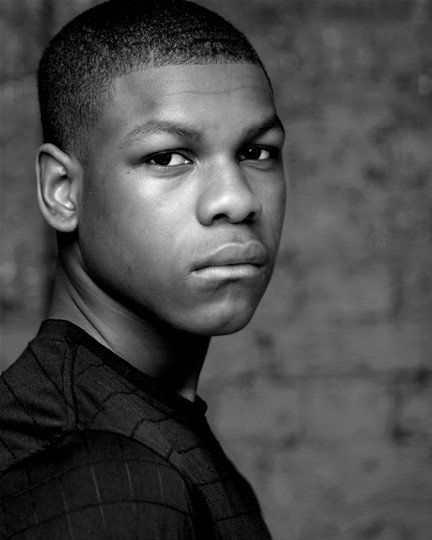
Boyega (above) is certainly an intriguing choice. I saw him in 2011’s hilariously enjoyable inner-city-teens vs. aliens comedy “Attack the Block.” It’s a small, independently produced British film but he made a big impression in it, playing a South London street thug who becomes an unlikely hero after an extraterrestrial invasion.

Adam Driver Domhnall Gleeson

Although Driver (above left) is probably the most recognizable name among the “Episode VII” cast, I’m perplexed by his presence here. I know his participation has long been rumored and this guy is a big deal in Hollywood right now, thanks to his breakout role on HBO’s “Girls.” I just can’t envision how he might fit into the world of “Star Wars.” He seems a little too contemporary and pip-squeaky to me. I hear rumors he might play a baddie, which could make sense, given how easily he evokes smugness. For now, though, I just don’t see it.

Gleeson (above right) has some major nerd cred already, having appeared in the Harry Potter movies as Bill Weasley, one of Ron’s many brothers. Last year, in the Richard Curtis dramedy “About Time,” he revealed a geeky sort of underdog charm, which might suit him to a Luke Skywalker-ish role. We’ll have to wait and see.

Oscar Isaac

I start to feel a lot better when I consider the presence of Isaac (above) on this list. The Juilliard educated actor made an inauspicious debut in 2006’s “Nativity Story” but has proved to be a major talent in such films as “Che,” “Robin Hood” and “The Bourne Legacy.” Last year, he was snubbed by the Academy for his riveting performance as a brilliant but tortured folk singer in the Coen Brothers’ “Inside Llewyn Davis.” Had he been nominated, he would have most definitely been my choice for best actor of 2013. He has a gift for delicately but fiercely conveying inner turmoil.

Von Sydow Gollum

Rounding out the more familiar names in the “Episode VII” cast are Max von Sydow and Andy Serkis.

Von Sydow is, of course, a veteran actor, Oscar-nominated star of such films as “Extremely Loud & Incredibly Close” and “Shutter Island.” He has a rich, smoky voice and the ability to portray sage warmth or profound menace. He could play a wizened, old Jedi or a sour Sith Lord with equal gusto.

Serkis is famous for portraying Gollum, the most convincing computer-generated motion capture creature ever to grace the screen, in the “Lord of the Rings” and “Hobbit” trilogies. His presence suggests we are going to be treated to yet another stunning piece of motion capture performance art and that a CG critter of awesome magnitude is about to be born — hopefully more Yoda than Jar Jar Binks.

 When I start to get nervous about all this, I remind myself that Abrams did an excellent job recasting “Star Trek” when he successfully rebooted his first famous sci-fi series. One must also remember that when Lucas debuted his original trilogy, no one knew who Ford, Hamill and Fisher were either and look how that turned out.

On the other hand, there is the lingering specter of a certain trilogy of prequels that shall not be named. Fans can argue all they like that it wasn’t really THAT bad, but let’s not kid ourselves. That cold, soulless, CGI-saturated, mitichlorian-ravaged slice of stinky cheese was a crushing disappointment and it scars me to this day.

It cannot happen again, J.J. My lightsaber-wielding heart can’t take it.

Do you hear me?


I Hope My Daughter Grows Up to Be a Nerd

Several years ago, when my husband and I still attended the San Diego Comic-Con — back when it was more fun than exhausting — we would occasionally observe a couple pushing a stroller through the crowd, grim looks on their faces as the Red Sea of sweaty fanboys refused to part for them.

“They’re nuts,” I used to say.

It was time for me to eat my words when we decided to take our 3-month-old daughter to WonderCon Anaheim, the cozier little sister to San Diego’s towering pop culture extravaganza.

We booked a hotel attached to the Anaheim Convention Center, packed up the million items of baby ephemera required for an overnight trip with an infant, outfitted the little munchkin in a yoda hat stitched by a crafty cousin and made the pilgrimage to our favorite geek mecca. Our baby’s “Doctor Who”-worshiping aunt came along for moral support.

Soon I had become one half of THAT couple, maneuvering a stroller through hordes of spandex-clad superheroes, unidentifiable anime critters and hairy dudes declaring, via T-shirt, their allegiance to DC or Marvel. As the husband headed off in the direction of the Warner Bros. panel, the aunt and I waited for the exhibit hall to open and my tiny daughter got her first eyeful of the convention’s colorful passersby.

As Batmen in black body armor, Stormtroopers armed with blasters, gender-bending Thors and Lokis, wispy Elsas from “Frozen” and a guy painted entirely silver to look like a certain surfboard-carrying comic book character paraded in front of her, my baby’s eyes grew wide. She had entered a strange new world.

photo 2

That’s when I got to thinking. Many parents want their children to grow up to be doctors, lawyers, ballet dancers, Olympic gymnasts or the president of the United States. Those pursuits are certainly admirable but when I think about my daughter’s future, I have a different fate in mind. I really hope she grows up to be a nerd.

I suppose the odds are in my favor. My little girl wakes up every morning in a house littered with the traces of her parents’ geekdom. Posters of “Star Wars” and “Lord of the Rings” line the walls. Display cases full of Legos dominate the living room. Boxes of action figures are crammed into closets. Shelves overflow with books, many of them science fiction and fantasy. And on the mantle over the fireplace sits one of those fancy replica lightsabers, a cherished Christmas gift from dad to mom. In this house, Sunday nights are dedicated to “The Walking Dead” and “Game of Thrones,” the latest “Star Wars” news is hashed over and then rehashed and though we’re not a big comic book family, you’d better believe we’ll be there Friday when the latest Marvel movie hits theaters.

Most of our friends are nerds, too. Unlike the stereotype, they’re not 35-year-old men living in their mothers’ basements, playing World of Warcraft and guzzling Mountain Dew. They’re well adjusted, intelligent, productive members of society who also happen to read feminist comic books, debate the merits of “Star Wars” vs. “Star Trek,” play “The Elder Scrolls” online, re-read the Harry Potter books annually, line up at midnight for movies, countdown to the next seasons of “Sherlock” and “Doctor Who” and get excited about Hayao Miyazaki.

These are some of the coolest, smartest, most fascinating people I know and that’s why I hope my daughter doesn’t choose to rebel against her nerd heritage in favor of a boring existence. Many people slog through life doing the bare minimum — going to work, going home to spend the night sitting in front of some reality TV show.

Nerds want more. They’re not satisfied with reality and the status quo. Their imaginations are always churning, always musing, always wondering: wouldn’t it be cool if … time travel was possible, vampires existed, the zombie apocalypse happened, there was life on other planets, some rich dude with a cave and clever gadgets could save society from the evil within or if a British time lord could alter the course of history.

Nerds are passionate and playful. When they care about something they really care. They don’t do things by halves. They’re obsessed and they want to share that obsession with you. They’re not content to just watch or listen, they want to live it, collect it, wear it on a T-shirt, write about it in an Internet chat room, join a club or — as evidenced by the number of people who indulge in cosplay at WonderCon and similar events around the country — transform themselves into their favorite characters.

photo 1

Some would argue that such obsessions are childish, pointless and don’t make a difference, but the sheer momentum of nerd passion has turned comic book and fantasy movies into a billion dollar industry in Hollywood, resurrected cancelled television shows, united scores of disconnected individuals and, yes, even accomplished some good in the world. Take, for instance, The Harry Potter Alliance, thehpalliance.org, a self-described “coalition” of Harry Potter fans who have launched campaigns for literacy, equality and human rights around the world, donating books to impoverished kids, sending disaster relief supplies to Haiti, building a library and pressuring Warner Bros. about the use of child labor in the manufacturing of Harry Potter chocolates.

I’d go so far as to say that the world would be a better place if we were all just a little bit nerdier. I hope my daughter grows up to love a television show dearly, to take an enthusiastic stance when it comes to “Star Wars” or “Star Trek,” Marvel or DC, to adore a movie so much she can’t stop talking about it, to create a costume so she can “become” her favorite cartoon character, to acquire a ravenous taste for books, especially fiction and fantasy. I hope she embraces and is embraced by other nerds as warmly as I have been embraced by them. If she can find it in her heart to do this, I know she’ll be happy.

Photos by Fawn Kemble


Spilling WonderCon’s Best Kept Movie Secret

Among the main attractions of WonderCon Anaheim are the movie panels, which are almost as much fun as hanging out with shameless exhibitionists clad in spandex. The latest edition of the giant Southern California nerd-fest, which wrapped yesterday, highlighted anticipated films “X-Men: Days of Future Past,” “How to Train Your Dragon 2,” “Dawn of the Planet of the Apes” and “Godzilla.”

However, the real thrill of the panels comes in the form of those little gems you discover when you least expect it. This year, the biggest surprise was director Matthew Vaughn’s upcoming comic book adaptation “The Secret Service.” Twentieth Century Fox unveiled some rough but intriguing footage of this stylized spy flick, despite the fact that Vaughn was reluctant to tip his hand so early, according to moderator Ralph Garman. The film is due for release in 2015.

Based on a comic book by Vaughn’s previous collaborators, “Kick-Ass” writer Matt Millar and artist Dave Gibbons, “The Secret Service” is about a rogue British intelligence agency designed to accomplish what the CIA and MI6 cannot. The movie stars Colin Firth,  Samuel L. Jackson and Michael Caine. It is also rumored to feature cameos by the likes of Taylor Swift, Lady Gaga, David Beckham and Elton John.

The footage unveiled Saturday featured Firth in proper English gentleman mode, sharing a pint of Guinness at a pub with a young British street punk played by Taron Egerton. Firth’s seemingly harmless secret agent is attempting to recruit the incredulous lad when the meeting is interrupted by a gang of thugs. The actor calmly strolls to the establishment’s double doors, slides the lock shut, then proceeds to kick his would-be assailants’ butts, making particularly ingenious use of his umbrella. Of course, Firth never breaks a sweat. His dry British wit is his deadliest weapon.

The scene was followed by a montage of clips that were equally tantalizing, suggesting “The Secret Service” is Vaughn at his best with the hilariously violent edge of “Kick-Ass,” the action movie panache of “X-Men: First Class” and the gritty British quirks of the director’s debut film, “Layer Cake.”

“The Secret Service” appears to make excellent use of Firth’s quintessential Britishness, for which he was celebrated in “The King’s Speech” and “Pride and Prejudice.” And then there is the unlikely presence of Jackson, apparently on a quest to pop up in every comic book movie known to man.

As Hollywood persists in stripping the pages of every graphic novel it can get its hands on, from Marvel’s invincible franchise machine to DC’s ever growing repertoire, “The Secret Service” looks to be a smaller, refreshingly original entry in a genre built on endless possibilities. You should be hearing a lot more about in the future.


Academy Chose the Wrong Oscar Doc

There’s nothing wrong with the documentary “20 Feet From Stardom.” The film shouts the praises of the unsung hero of rock ‘n’ roll, the backup singer, showcasing the impressive pipes of big-voiced industry legends, including Merry Clayton, Darlene Love, Tata Vega and Lisa Fischer. This fun, upbeat movie, which touches briefly on racial issues, recently won the Oscar for best documentary, probably because it tickled some nostalgic sweet spot in the memories of the aging members of the Academy of Motion Picture Arts and Sciences.

Directed by seasoned documentarian Morgan Neville, “Stardom” is a perfectly decent work of nonfiction film, but it pales in comparison to at least two of the five nominees, “Cutie and the Boxer” and “The Act of Killing.” Though I haven’t had the chance to watch the remaining nominees — “The Square,” about Egyptian revolutionaries, and “Dirty Wars,” which examines the history of America’s “covert” armed conflicts — I suspect it pales in comparison to them as well. (Nevermind that two of the best documentaries of 2013 were completely overlooked by the Academy: “Stories We Tell,” Sarah Polley’s stunning rumination on family, truth and identity, and the damning Sea World expose “Blackfish.”)

“Cutie and the Boxer” and “The Act of Killing” are ten times more compelling, ambitious and important than the entertaining but relatively unprofound “20 Feet From Stardom.” Lucky for us, they also happen to be available for home viewing.

“Cutie” recounts the unusual love story of Ushio Shinohara, an 80-year-old Japanese pop artist known for the “action paintings” he creates using boxing gloves tipped with foam, and his long-suffering wife Noriko, an artist in her own right who lives hidden in his shadow. Playfully and imaginatively directed by Zachary Heinzerling, the film documents the pair’s affectionate yet combative relationship, which raises fascinating questions about art and commerce, love and self-sacrifice and whether it is possible for two artists to live together as equals.

Ushio’s ego may be as outsized as the giant motorcycle sculptures he creates, but it is Noriko  — aka “Cutie” — who emerges as the real star of the film. Arriving in New York City as a young art student, she promptly falls for Ushio and his avant garde ideals, despite a 20-year age difference. Giving up her creative dreams to essentially become an assistant to the mercurial, alcoholic artist, she finds herself pregnant, poor — Ushio is celebrated but his art doesn’t sell — and increasingly embittered.

Later in life, however, she begins to emerge from her husband’s shadow, writing and illustrating a striking graphic novel that tells the story of their marriage, following the exploits of the naked, pigtailed Cutie. Suddenly it seems the genuine talent in the family may have been overlooked. The intriguing saga of a remarkable woman becomes a messy, melancholy but transcendent tale of liberation.

Even more astonishing is “The Act of Killing,” an innovative and deeply disturbing documentary by Texas native Joshua Oppenheimer. The film follows Indonesian death squad leader Anwar Congo and his cohorts as they reenact their past crimes against humanity in the style of Hollywood movies.

Anwar and his swaggering friends presided over a bloody extermination that resulted in the deaths of millions of so-called Communists after the government of Indonesia was overthrown by the military in 1965. Never called to account for the killings, these unrepentant gangsters proudly recount the influence of American cinema on their self-styled thug-dom, relishing the process of turning their violent acts into a movie, complete with gory special effects, makeup, elaborate sets, dancing girls, torture scenes and one particularly rotund gangster in drag.

As they set about making the film they imagine will cement their place in history, with all the enthusiasm of neighborhood kids putting on a show, Anwar and his fellow mass murderers begin to debate the impact the truth might have on their legacy in a running dialogue that gradually becomes as surreal as the images on screen. Even more unexpectedly, Anwar develops a conscience as he’s confronted with the memory of the hundreds of sadistic slayings he committed in his youth.

A dark and complex exploration of a national history steeped in corruption and self-delusion, “The Act of Killing” becomes a portrait of a man haunted by unforgivable sins. There are no backup singers doo-wopping in the background, just an eyeful of human nature at its very worst.

From Lupita’s Dress to ‘Adele Dazeem,’ Musings on Hollywood’s Big Night

For some of us — I’ll admit, a very small segment of the population — the Oscars are like the Super Bowl. We spend months speculating about the nominations, making sure we’ve seen the films, taking our best shot at who will go home with the gold on the big night. And now that Sunday’s ceremony is over, the trophies handed out, the designer gowns worn, the after-party champagne sipped, there is still a lot to talk about. Here are some thoughts.

1. After establishing herself as a fashion icon throughout the awards season with her simple but bold choices, best supporting actress nominee Lupita Nyong’o unveiled her pièce de résistance at the Academy Awards, creating a sensation in her floaty, pale blue Prada gown. This stunning dress is destined to go down in red carpet history and stood in tasteful and fanciful contrast to some of the night’s more bizarre sartorial moments — Anne Hathaway wearing a chandelier, Liza Minnelli in silk pajamas and Whoopi Goldberg as flapper/geisha/Seinfeld’s puffy shirt/Wicked Witch of the  West.

Nyong’o’s gown couldn’t have been more appropriate for her fairy tale moment when she took the podium to claim the prize for her harrowing work in “12 Years a Slave.” Her acceptance speech was one of the highlights of the evening, heartfelt, brimming with joy and elation.

“It doesn’t escape me for one moment that so much joy in my life is thanks to so much pain in someone else’s,” she said. “And so I want to salute the spirit of Patsey for her guidance. And for Solomon, thank you for telling her story and your own. … When I look down at this golden statue, may it remind me and every little child that no matter where you’re from, your dreams are valid.”

Moments like these are the reason we watch the Oscars.

2. Was it just me or were there an inordinate amount of awkward Teleprompter related gaffes during this year’s ceremony?

When  it came to reading their lines, so many presenters stumbled — metaphorically, except in the case of Jennifer Lawrence, who continued her tradition of taking a fall while wearing sky-high heels.

Silver screen legends Kim Novak and Sidney Poitier really needed their glasses. Zac Efron botched his scripted patter. Even host Ellen DeGeneres flubbed, calling actor Christoph Waltz “Christopher.” There were so many awkward moments, but none of them quite as hilarious as when John Travolta introduced “Frozen” star Idina Menzel as “Adele Dazeem.”

His error has turned into something of a social media sensation. Slate even concocted this hilarious name generator based on the goof.

http://www.slate.com/articles/arts/low_concept/2014/03/john_travolta_called_idina_menzel_adele_dazeem_what_s_your_travolta_name.html

All of this makes me wonder. Did anyone actually rehearse before the ceremony?

3. Matthew McConaughey’s win for a role that demanded a transformation of career and body in “Dallas Buyers Club” wasn’t exactly a surprise, but his resulting comments are now the talk of Tinseltown. Many people were delighted by his mention of God, gratitude and family. Others, like me, were baffled by his improvisational style.

In regard to a higher power, McConaughey said, “When you’ve got God, you got a friend. And that friend is you.”

In reference to his dearly departed dad: “To my father who, I know he’s up there right now with a big pot of gumbo. He’s got a lemon meringue pie over there. He’s probably in his underwear. And he’s got a cold can of Miller Lite and he’s dancing right now.”

And then he pretty much shattered his previous humility by declaring himself his own hero. Well, sort of.

“I’m never gonna be my hero. I’m not gonna attain that. I know I’m not, and that’s just fine with me because that keeps me with somebody to keep on chasing.”

It was all only slightly less surreal than his Screen Actors Guild Awards speech, in which he made wacky reference to the planet Neptune, or his remarks at the Golden Globes, which revealed that apparently his wife calls him her “king.”

Whatever your reaction, you have to admit there’s never a dull moment when this guy takes the stage.

4. A spirited Cate Blanchett accepted her trophy for “Blue Jasmine” with the immortal words, “Julia, hashtag suck it!,” referring somewhat cryptically to Julia Roberts.

More memorably, she called out a male dominated Hollywood on the woeful lack of satisfying roles for women, slamming those “who are still foolishly clinging to the idea that female films with women at the center are niche experiences. They are not. Audiences want to see them, and in fact, they earn money. The world is round, people!”

It needed to be said.

5. After last year’s poorly received performance by host Seth MacFarlane, whose caustic and sometimes offensive schtick rubbed Hollywood the wrong way, the Oscar producers’ pendulum predictably swung to another extreme in the form of the ever likable, always pleasant DeGeneres.

Don’t get me wrong. Hosting for a second time, Ellen was great, cultivating a playful atmosphere with gentle jabs at celebs during her opening monologue. She treated the bejeweled audience to pizza, stole Nyong’o’s lip balm and coaxed Angelina Jolie, Brad Pitt, Bradley Cooper, Meryl Streep and other luminaries into posing for that now famous selfie.

Despite her best efforts, however, this year’s ceremony often felt tedious and tame. There were few surprises when it came to the winners — “Gravity” dominated with seven trophies; “12 Years a Slave” took the best picture prize — and only a handful of moments that resonated with the genuine emotion that keep Oscar viewers coming back for more.

This year’s theme was dedicated to movie heroes, but the ensuing montages were so generic they barely registered. Bette Midler sang “Wind Beneath My Wings” after the traditional In Memoriam segment and received one of several overeager standing ovations, but considering the song is more than 30 years old, it was a strangely stale choice.

Ultimately, the 86th Academy Awards were done in by a stultifyingly conservative aura. Nobody ever got the gold by playing it safe.

Stop Grousing and Go See ‘Gravity’

This year’s Academy Awards race is one of the closest in recent memory with three of the nine films nominated for best picture in a tight heat. Oscar analysts agree that at the conclusion of Sunday’s ceremony, Hollywood’s most coveted prize will be presented to the producers of either “Gravity,” “12 Years a Slave” or “American Hustle.”

Entertainment Weekly, in its Oscar predictions issue, forecasts that 19% of the Academy vote will go to “Gravity,” with 18% for “12 Years a Slave” and “American Hustle” with 16% of the ballots. Last month, in a rare occurrence, “Gravity” and “12 Years” tied for the top prize at the Producers Guild Awards. The ceremony is usually a good predictor of Oscar outcomes.

For months, the three front-runners have generated considerable buzz. “Gravity” racked up an impressive $700 million at the global box office. “American Hustle” crossed the $200 million mark and even the harrowing “12 Years” drummed up $100 million in ticket sales. The fact remains, however, that many people have not bothered to head to the theater to see what all the fuss is about.

Of course, this isn’t unusual when it comes to the Oscars, a ceremony that is treated with reverence in Tinseltown but tends to elicit yawns from an indifferent general public. Unless it’s one of the few years in which a major blockbuster is nominated — “Avatar,” for instance, viewed by practically everyone on the planet — it’s common for best picture candidates to languish unseen.

But this time around, the front-runners are worthy of your time and attention. In a year of exceptional films, they are the best Hollywood had to offer — a visually innovative cosmic thriller; a brutally honest historical drama; and a shamelessly entertaining glitter-pile of 1970s glam.

Oddly enough, it is “Gravity” that seems to have encountered the most resistance from a certain segment of filmgoers. I’ve talked to a number of people who stubbornly turn up their noses at Alfonso Cuaron’s space odyssey. Perhaps their reticence stems from the film’s minimalist but epic premise. At first I couldn’t imagine what could possibly be so compelling about watching Sandra Bullock and George Clooney float around in outer space.

Still, the skepticism is baffling, considering what a taut nail-biter of a thriller the film is, not to mention its stunning visual achievements and emotional heft. If you’re lucky enough to find a place where you can still catch an IMAX screening of the movie, it will be one of the most suspenseful, immersive, uplifting and intense cinematic experiences of your life. The film was released Tuesday on Blu-ray, so you can watch it from the comfort of your couch, but you’ll be missing out. If ever a film demanded to be seen on the biggest screen possible — preferably in 3-D with a kick-ass sound system — this is it.

The story of a medical engineer adrift after her space shuttle is torn to shreds, “Gravity” features one of Bullock’s most fragile and moving performances. The film ingeniously registers on two levels – it’s one heck of a popcorn movie ride but it’s also packed with existential symbolism and musings on hope, rebirth and the significance of humanity in a terrifyingly infinite universe. It’s as deep or as shallow as you want it to be.

“American Hustle” is an easier sell. Directed by “Silver Linings Playbook” helmer David O. Russell and reuniting several members of that crowd-pleasing comedy-drama’s cast, “Hustle” is a trashy, over-the-top romp through 1970s sleaze and the most fun many of us had at the movies in 2013.

Nothing about the film is hard to love, from the gloriously kitschy period costumes and art direction, to the go-for-broke acting, to the twisty plot about a pair of con artists embroiled in a government sting operation. Bradley Cooper’s perm and Christian Bale’s comb-over may appear to steal the show, but it is the film’s leading ladies – both nominated for Oscars – who are the real stars. Amy Adams, as a chameleonic temptress looking for love, and Jennifer Lawrence, as an unstable, accident-prone housewife, deliver the most mesmerizing performances of their already accomplished careers.

“12 Years a Slave” is difficult to love, despite the fact that it is quite possibly the most authentic movie of its kind. While other films about America’s dirty, devastating past soft-pedal the indignities of slavery, director Steve McQueen lays them bare in merciless fashion, making for a film that is necessary, yet excruciating. After seeing it, my husband and I were silent the whole way home. There was literally nothing to say in the aftermath of so much shame and sadness.

McQueen specializes in depicting human depravity and desperation — he made a movie titled “Shame,” after all — and “12 Years” is his masterwork. It is brilliantly acted with performances so naked, it’s hard to look them in the eye — Chiwetel Ejiofor as the kidnapped Solomon Northup, Michael Fassbender as a lascivious slave owner and, most searing of all, Lupita Nyong’o as the tormented target of that slave owner’s twisted obsession.

Yes, “12 Years” is painful to watch, but that doesn’t mean you shouldn’t watch it, even if you only watch it once. The film has profound and indispensable things to say about the insidious nature of racism.

There are great treasures to mine, great revelations to discover in Oscar’s favorite trio and time and opportunity to rectify what you’ve missed, long after the Oscars are over.

Why deprive yourself of greatness?

Philip Seymour Hoffman: The Man in the Beanie

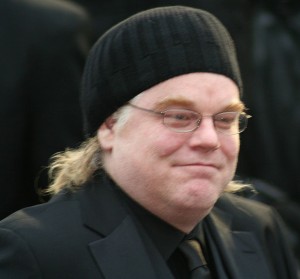
One of my fondest memories of Philip Seymour Hoffman is the night he attended the 2009 Oscars. Like the other men at the ceremony, he was clad in the traditional tuxedo, except that his straw colored hair exploded wildly from beneath a black beanie. Brazenly disheveled, he looked a bit like Steve Zissou or someone who had wandered in off the street, ambushed George Clooney and stolen his suit.

I mean, who attends the Oscars in a beanie?

That is exactly the sort of actor Hoffman was – immune to vanity, deeply committed to melting into character, respected by his peers for his dedication and craft, but existing outside the shallow Hollywood circus that tends to consume more self conscious performers.

Hoffman died of a suspected drug overdose on Feb. 2, but he won’t be remembered for weird tabloid exploits or even for his struggles with addiction. Already, as we mourn his demise, we’re celebrating his work and the fact that when his name popped up in a film’s credits, you knew you were about to see something memorable. Even when the movie wasn’t all that great – “Along Came Polly” comes to mind – Hoffman was never less than electrifying.

Pasty and portly with a sardonic grin and a voice like pebbles rolling around in the surf, Hoffman was the rare character actor who could shoulder the weight of a lead role and make it look easy. After his 1991 debut in an episode of “Law & Order,” the native New Yorker made his name by embracing challenging and eccentric roles on the big screen and the stage.

His early work included small but significant parts in “Scent of a Woman,” “Twister,” “Boogie Nights” and “The Big Lebowski.” He was nominated for an Oscar on four occasions, winning in 2006 for “Capote,” the role that would come to define his career. He was most comfortable inhabiting the skin of lonely misfits (“Synecdoche, New York”), tortured souls (“Doubt”), unapologetic crackpots (“Charlie Wilson’s War”), clever schemers (“Mission: Impossible III,” “The Hunger Games: Catching Fire”) and men as passionate as they were stubborn (“Moneyball”).

It’s nearly impossible to condense Hoffman’s sublime repertoire into a Top 5 list, but in honor of this great actor’s life and life’s work, I offer up a handful of the roles I will always look back on with fondness. They’ll remain worthy of repeat viewings for years to come.

 “Magnolia,” 1999: Hoffman first came onto my radar playing the compassionate nurse to Philip Baker Hall’s dying television producer in frequent collaborator Paul Thomas Anderson’s mesmerizing and perplexing magnus opus, a film that famously ends with a plague of frogs. I saw this movie alone in a nearly empty theater in Westwood and sobbed my way through most of it. It boasts a killer ensemble cast, including Julianne Moore, William H. Macy, John C. Reilly and Tom Cruise in an eye opening role as a misogynistic motivational speaker, but it is Hoffman’s hushed performance that still haunts me.

“Almost Famous,” 2000: My hands-down favorite of Hoffman’s roles, the character of Lester Bangs is one for the ages. As the acerbic music critic who serves as mentor to Patrick Fugit’s budding rock writer in Cameron Crowe’s autobiographical coming-of-age story, the actor oozes wisdom and cool authority. If Fugit’s wide-eyed William is the heart of Crowe’s love letter to those who eat, breathe and live rock ‘n’ roll, Lester is the soul, mourning the passing of one of music’s great eras. His advice to young William — “Be honest and unmerciful” — delivered with Hoffman’s trademark blend of sarcasm and sadness, should be every journalist’s motto.

 “Capote,” 2005: Taking on the role of Truman Capote was a bold move for Hoffman. Given the “In Cold Blood” author’s distinctive voice and eccentric mannerisms, the part could have easily devolved into caricature. Hoffman’s performance is so layered and so human, he coaxes us into empathizing with this strange little man and the dark and conflicted impulses he wrestles with as he connects with a suspected killer. Shortly after the release of “Capote,” Toby Jones offered his take on the character and did a perfectly decent job, but the film seemed utterly superfluous after Hoffman had so fully inhabited the part.

“Charlie Wilson’s War,” 2007: Hoffman’s gift for milking madcap laughs is on full display in this Aaron Sorkin-scripted political comedy detailing the beginnings of the United States’ ill fated meddling in Afghanistan as the Cold War drew to a close. Playing eternally frustrated CIA chief Gust Avrakotos opposite Tom Hanks and Julia Roberts, the actor sports a furry mustache and tinted aviator sunglasses and radiates hilarious intensity as he spouts some of Sorkin’s pithiest monologues. The role earned Hoffman an Oscar nomination for best supporting actor.

 “The Master,” 2012: Paul Thomas Anderson’s most recent film is difficult to watch and many moviegoers found it even more difficult to love. It is, however, an excellent showcase for Hoffman’s unparalleled ability to tap into the charisma and power of ambitious, self deluded men. In the film’s showiest role, would-be disciple Freddie Quell, Joaquin Phoenix nabbed a nomination for the best actor Oscar, relegating his co-star to the supporting category, but Hoffman’s portrayal of a mysterious cult leader, inspired by Scientology creator L. Ron Hubbard, is essential to the film. It’s a towering performance and it reaches its zenith in a scene in which Hoffman’s Lancaster Dodd pokes into the dark recesses of Freddie Quell’s personal life in an uncomfortably intimate psychological interrogation. Dodd’s methods may be absolute quakery but the moment reverberates with naked truth.